
Wheel Custom: Choosing the Right Custom Wheels for Your Car
Wheel Custom: Choosing the Right Custom Wheels for Your Car
Upgrading your vehicle with a set of aftermarket wheels is single-handedly the most impactful modification you can make. Beyond drastically altering your vehicle’s stance and aesthetic profile, selecting the right custom setup influences unsprung weight, acceleration dynamics, braking efficiency, and high-speed cornering stability.
However, navigating the technical landscape of aftermarket fitments can quickly become overwhelming. Between calculating exact offset millimetres, understanding structural grain alignment during manufacturing, and choosing a finish capable of surviving harsh seasonal road salt, a single miscalculation can turn a major upgrade into a costly mistake involving fender rub, brake caliper interference, or high-speed steering wheel wobble.
Whether you are aiming to flush out the stance on a daily driver, shave crucial pounds of unsprung mass off a track machine, or fit aggressive off-road fitments on a lifted truck, this complete breakdown covers every technical detail necessary to select custom wheels with absolute precision.
1.Manufacturing Methodologies: How Construction Shapes Performance
When evaluating custom wheels, structural manufacturing dictates strength, overall weight, impact resistance, and cost. Modern wheel production falls into three primary categories: cast, flow-formed, and fully forged.
| Feature | Cast Custom Wheels | Flow-Formed Custom Wheels | Fully Forged Custom Wheels |
|---|---|---|---|
| Primary Process | Liquid alloy poured into a mold | Cast blank stretched with heated rollers | Solid 6061-T6 aluminum block compressed under extreme force |
| Tensile Strength | Standard | High | Maximum |
| Grain Structure | Porous / Random | Dense / Flow-aligned | Highly Compressed / Continuous |
| Unsprung Mass | Highest | Moderate | Lowest |
| Price Tier | Budget / Entry-Level | Mid-Tier Performance | Premium / Custom Built |
1. Cast Wheels
Cast construction represents the traditional industry standard for aftermarket wheels. Molten aluminum alloy is poured into a pre-shaped steel mold and allowed to cool. Once solidified, the wheel undergoes finishing, CNC machining, and coating.
-
Pros: Highly cost-effective; available in virtually unlimited face designs and spoke configurations.
-
Cons: The cooling process allows microscopic air pockets to form within the alloy matrix, resulting in lower grain density. To achieve necessary safety standards, manufacturers must use more material, making cast wheels noticeably heavier.
-
Best For: Daily commute vehicles, winter setups, or show builds where ultimate structural lightweight performance is not a strict requirement.
2. Flow-Formed Wheels
Flow-forming—also referred to as flow-forging or rotary forging—serves as the bridge between traditional casting and premium forging. The manufacturing process begins with a specially cast low-pressure wheel blank. The inner barrel section is then mounted on a mandrel, heated to high temperatures, and spun while hydraulic rollers apply intense pressure to stretch and compress the aluminum along the barrel.
-
Pros: The hydraulic rolling pressure realigns the aluminum’s crystalline structure, increasing tensile strength within the rim barrel to levels approaching fully forged wheels. This allows for a thinner, significantly lighter outer rim profile.
-
Cons: While the rim barrel gains high strength and weight reduction, the face structure remains cast.
-
Best For: Performance-minded enthusiasts, track day drivers, and daily commuters looking for an ideal balance of weight reduction and value.
3. Fully Forged Wheels
Forged construction represents the pinnacle of custom wheel engineering. Rather than melting metal down into a liquid state, production starts with a solid billet block of aerospace-grade 6061-T6 aluminum. This block is subjected to massive hydraulic pressures—often exceeding 10,000 tons—to forge a dense, continuous grain structure. Precision CNC milling machines then carve the intricate spoke architecture directly out of the dense forged blank.
-
Pros: Maximum structural density, exceptional shock resistance, and the highest strength-to-weight ratio achievable. Unsprung mass is minimized without sacrificing rigidity under heavy cornering loads.
-
Cons: Requires specialized machinery and long machining cycle times, resulting in a premium price point.
-
Best For: High-performance sports cars, heavy-duty trucks requiring maximum load ratings, dedicated race cars, and bespoke custom builds requiring custom offsets and bolt patterns.
2.Fitment Math: Mastering Wheel Offset and Backspacing
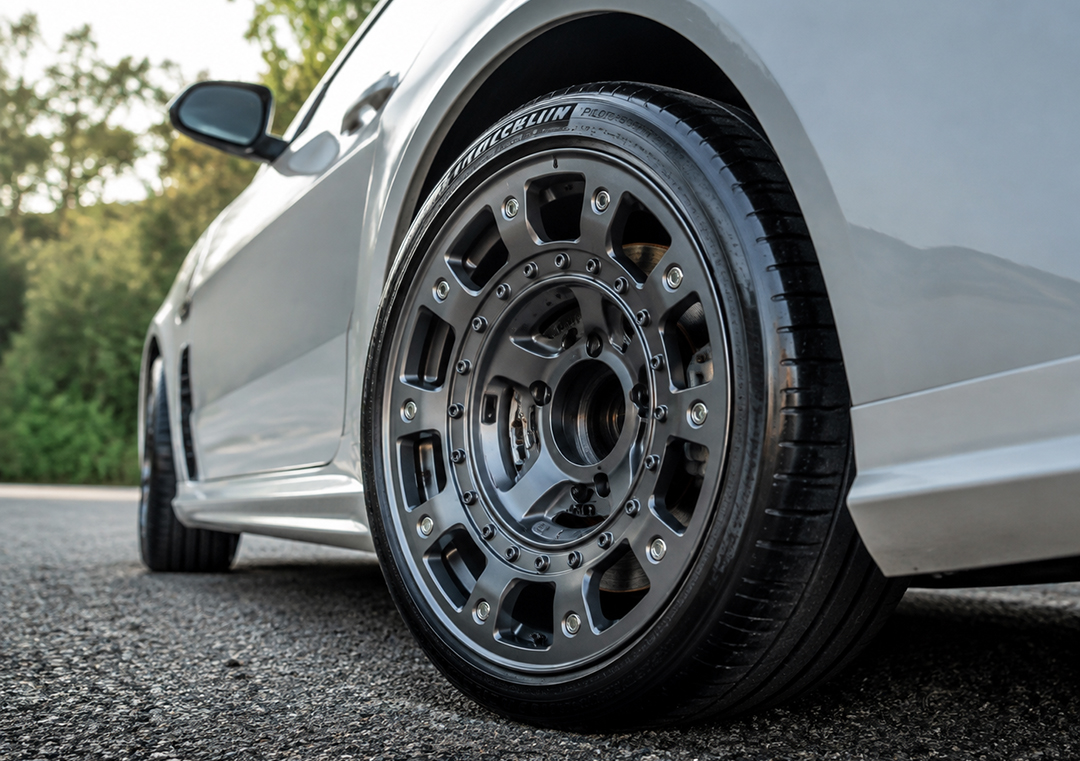
Correct fitment ensures that your wheels clear inner suspension struts, clear large multi-piston brake calipers, and sit flush with the body lines without making contact with outer fender lips. Achieving the ideal setup requires a solid grasp of offset and backspacing.
Understanding Wheel Offset (ET)
Offset, measured in millimeters and designated by the German term Einpresstiefe (ET), represents the exact distance between the wheel’s physical centerline and the flat mounting hub surface that bolts against your vehicle’s brake rotor.
-
Positive Offset (+ET): The mounting hub surface sits toward the front (street side) of the wheel. Positive offset draws the wheel inward toward the vehicle’s suspension. Most modern front-wheel drive and all-wheel drive passenger cars come from the factory with medium-to-high positive offset, typically ranging between +35mm and +50mm.
-
Zero Offset (ET0): The mounting hub surface sits completely flush with the exact mathematical centerline of the total rim width.
-
Negative Offset (-ET): The mounting hub surface sits toward the back (suspension side) of the wheel. This pushes the wheel face outward away from the body, creating a deep lip profile. Negative offsets are common on off-road trucks, classic muscle cars, and aggressive wide-body builds.
Understanding Backspacing
While offset measures from the wheel’s centerline, backspacing measures the total distance from the rear edge of the wheel rim to the mounting hub surface. Backspacing is expressed in inches.
-
Why It Matters: Backspacing is the critical metric for verifying inner clearance. If your backspacing measurement is too deep, the inner rim lip or tires will rub against internal coilover springs, control arms, or sway bar links during full steering lock.
3.Hub-Centric vs. Lug-Centric Fitments
One of the most common causes of steering wheel vibration at highway speeds involves a mismatch between the wheel’s center bore and the vehicle’s axle hub interface.
Hub-Centric Setups
A hub-centric custom wheel features a center bore machined to match the exact diameter of your vehicle’s factory axle hub flange down to fractions of a millimeter. When mounted, the vehicle’s weight rests directly on the solid steel axle hub, while the wheel bolts or lug nuts serve exclusively to keep the wheel secured flat against the brake hat.
Lug-Centric Setups
Lug-centric wheels feature a larger universal center bore designed to fit multiple vehicle applications with varying hub diameters. Because the center bore does not fit snugly against the vehicle’s hub, the wheel relies entirely on the tapered conical seats of the lug nuts to align itself on the hub.
-
The Problem: Even minor torque imbalances during installation can leave the wheel mounted slightly off-center by a fraction of a millimeter. At 65 mph, this subtle eccentric mounting creates noticeable high-speed wheel wobble.
-
The Solution: Whenever installing aftermarket wheels with a larger universal center bore, always install high-grade aluminum or heat-resistant polycarbonate hub-centric rings. These rings fill the gap between the vehicle’s hub and the wheel’s center bore, restoring a precise hub-centric fitment and eliminating vibration.
4.Impact on Vehicle Dynamics, Speedometer Calibration, and Ride Quality
Upgrading custom wheels involves adjusting proportions. Changing the overall wheel diameter and tire sidewall profile directly impacts ride characteristics and instrument accuracy.
1. Unsprung Weight and Rotational Mass
Unsprung mass includes all vehicle components situated below the suspension springs—such as wheels, tires, brake assemblies, and wheel bearings. Lowering unsprung mass allows suspension dampers to respond faster to uneven road surfaces, keeping the tire contact patch firmly planted.
Additionally, because wheels act as rotating flywheels, reducing wheel mass reduces rotational inertia. A lighter forged wheel requires less kinetic energy to accelerate and stop, resulting in sharper throttle response and reduced braking distances.
2. Speedometer and Odometer Accuracy
Your vehicle calculates speed readings based on tire rotation counts. The overall rolling diameter is determined by adding the wheel diameter to twice the tire sidewall height (which is calculated by multiplying tire width by the tire aspect ratio percentage). If you switch to a larger wheel size—such as stepping up from an 18-inch setup to a 20-inch setup—you must reduce the tire profile aspect ratio accordingly to maintain the factory overall rolling diameter.
-
If the total rolling diameter increases: The tire rotates fewer times per mile, causing your speedometer to read lower than your actual road speed.
-
If the total rolling diameter decreases: The tire rotates more times per mile, causing your speedometer to read higher than your actual road speed.
3. Ride Quality and Handling Compliance
Increasing wheel diameter while decreasing tire sidewall height (often called “plus-sizing”) stiffens the tire sidewall. While shorter sidewalls minimize lateral flex under hard cornering—delivering sharper steering feedback—they provide significantly less air cushion to absorb potholes and road seams, resulting in a firmer ride.
5.Surface Finishes: Durability, Aesthetics, and Maintenance
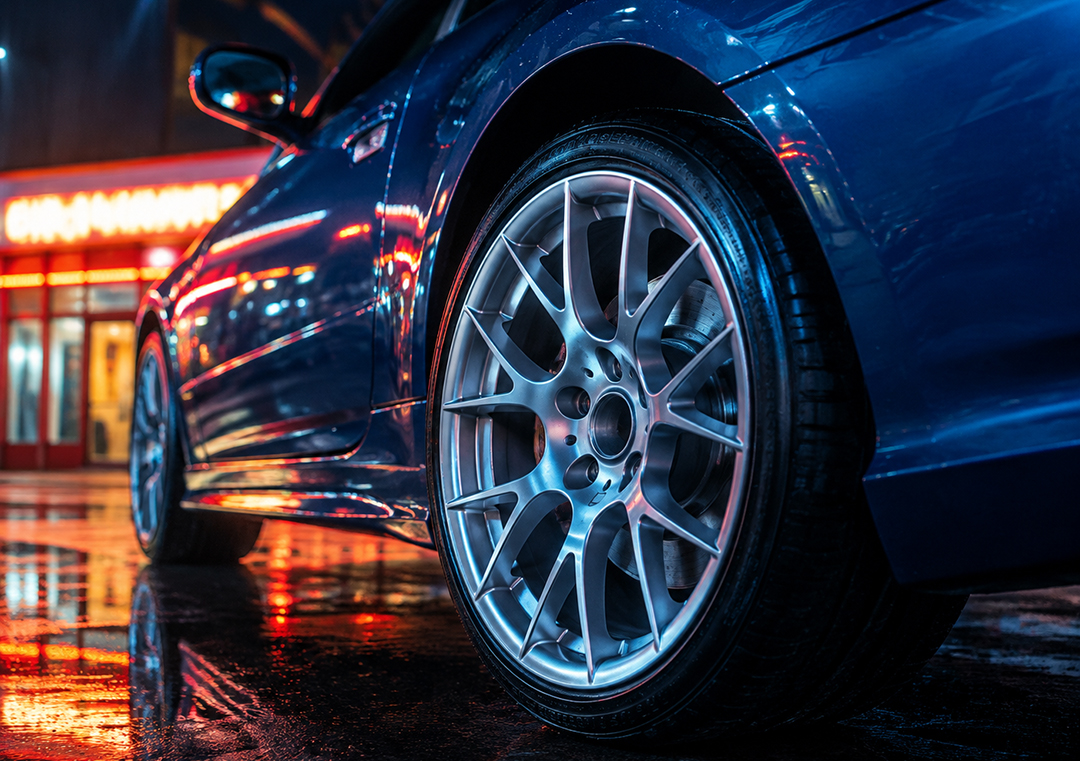
Custom wheels endure harsh operational environments, including extreme brake heat, acidic road debris, brake dust corrosion, and winter de-icing chemicals. Selecting the right finish requires balancing visual preference with maintenance expectations.
-
Powder Coating: Polymer resin is baked onto the surface to create a satin, gloss, or matte finish. It delivers exceptional environmental resistance, withstands harsh road conditions easily, and requires very low maintenance.
-
Chrome Plating: Electroplated chrome provides a brilliant mirror reflection achieved by applying layers of copper, nickel, and chromium onto the aluminum surface. It offers a timeless aesthetic but requires frequent cleaning to prevent pitting or peeling from road salt.
-
Machined and Clear-Coated Finishes: A CNC diamond-bit cutter shaves off an ultra-thin layer of aluminum across the wheel face to create fine metallic lines sealed under a clear coat. This delivers a multi-dimensional two-tone look with good durability.
-
Raw Polished Aluminum: Bare aluminum is mechanically buffed to a deep mirror finish without an outer clear coat seal. It provides unmatched depth of luster but requires regular polishing to avoid surface oxidation.
1. Powder Coating
Powder coating involves applying dry polymer resin powder via an electrostatic charge and baking the wheel in an oven to melt and cure the finish into a uniform layer.
-
Pros: Highly resistant to chipping, harsh brake dust, and salt corrosion. Excellent longevity for year-round daily driving.
-
Cons: Requires complete chemical stripping to refinish if deep curb damage occurs.
2. Chrome Plating
Electroplated chrome provides a brilliant mirror reflection achieved by applying layers of copper, nickel, and chromium onto the aluminum surface.
-
Pros: Timeless high-shine aesthetic.
-
Cons: Prone to pitting, flaking, and peeling if exposed to harsh road salt or acidic wheel cleaners. Requires frequent hand cleaning and seasonal sealing.
3. Machined and Clear-Coated Finishes
A CNC diamond-bit cutter shaves off an ultra-thin layer of aluminum across the wheel face, creating fine metallic concentric lines that catch the light, while recessed spoke areas receive painted accents. A protective clear coat seal is applied over the top.
-
Pros: Offers a clean, multi-dimensional two-tone look.
-
Cons: If road debris chips the outer clear coat, moisture can creep underneath the protective layer, creating fine lines of oxidation that require professional refinishing.
4. Raw Polished Aluminum
Bare polished aluminum is mechanically buffed until it reaches a deep mirror finish, left unsealed without a protective clear coat layer.
-
Pros: Provides an unmatched depth of luster that clear coats can dull. Minor scratches can be polished out by hand.
-
Cons: Lacks a protective barrier against oxidation. Must be polished regularly with specialized aluminum metal polishes to prevent surface clouding.
6.Essential Maintenance & Care Protocols
To preserve the appearance and structural safety of your custom wheels, follow these essential maintenance practices:
-
Clean Cold Wheels Only: Never spray water or chemical cleaners on wheels hot from driving. Sudden temperature shifts can warp brake rotors or thermal-shock clear coat finishes, leading to premature clear coat peeling.
-
Use pH-Neutral Cleaners: Avoid harsh acid-based cleaners. Stick to dedicated pH-neutral wheel cleansers and soft microfiber wash mitts to protect clear coats, powder coats, and anodized hardware.
-
Always Hand Torque Lug Nuts: Pneumatic impact wrenches can unevenly stretch wheel studs or distort custom wheel mounting faces. Always use a calibrated torque wrench to tighten lug nuts to factory torque specifications using a star pattern.
-
Apply Protective Sealants: Apply a high-quality ceramic coating or specialized wheel wax every few months. This hydrophobic barrier prevents hot brake dust from embedding directly into the finish, making routine wash cycles far easier.
Frequently Asked Questions(FAQ)
Q1: Can I reuse my factory original equipment tires on aftermarket custom wheels?
Yes, provided the aftermarket wheels match your factory wheel diameter and fall within the recommended rim width range for your current tire width. Installing a tire on a wheel rim that is too wide or too narrow distorts the tread footprint, resulting in uneven tire wear and reduced traction.
Q2: What is the bolt pattern (PCD), and how is it measured?
PCD (Pitch Circle Diameter) consists of two numbers: the number of lug holes and the diameter of the imaginary circle they form (such as 5×114.3 or 6×139.7). On 4-, 6-, and 8-lug wheels, measure center-to-center across opposing lug holes. On 5-lug wheels, measure from the outer edge of one hole to the exact center of the second hole opposite it.
Q3: What are directional custom wheels?
Directional wheels feature asymmetric spoke designs angled to push or pull air as they rotate. True directional wheels are manufactured in dedicated left-hand and right-hand mirror pairs so that the spokes point in the same relative direction on both sides of the vehicle.
Q4: Why do some custom wheels require tuner-style lug nuts?
Many aftermarket wheel designs feature smaller, narrow lug holes that cannot accommodate standard factory hex sockets. Tuner-style lug nuts feature smaller outer diameters and require a thin-wall key adapter to tighten without scratching the wheel finish.
Q5: How do wide custom wheels impact wheel bearing life?
Running extremely low or negative offset setups pushes the centerline of the wheel further outward from the hub. This creates an increased leverage arm on your vehicle’s wheel bearings, which can accelerate wear on factory wheel hub assemblies over time.
Build Your Stance with Precision Engineering
Choosing the right custom wheels involves an ideal balance of functional engineering and personal style. By carefully considering manufacturing construction, verifying hub-centric clearance, calculating proper offset and backspacing, and applying appropriate surface maintenance, you can upgrade your vehicle’s stance and handling performance with total confidence.
Ready to transform your build with precision-engineered fitments? Explore the latest designs, technical specifications, and custom wheel options at ATK Wheels today.

