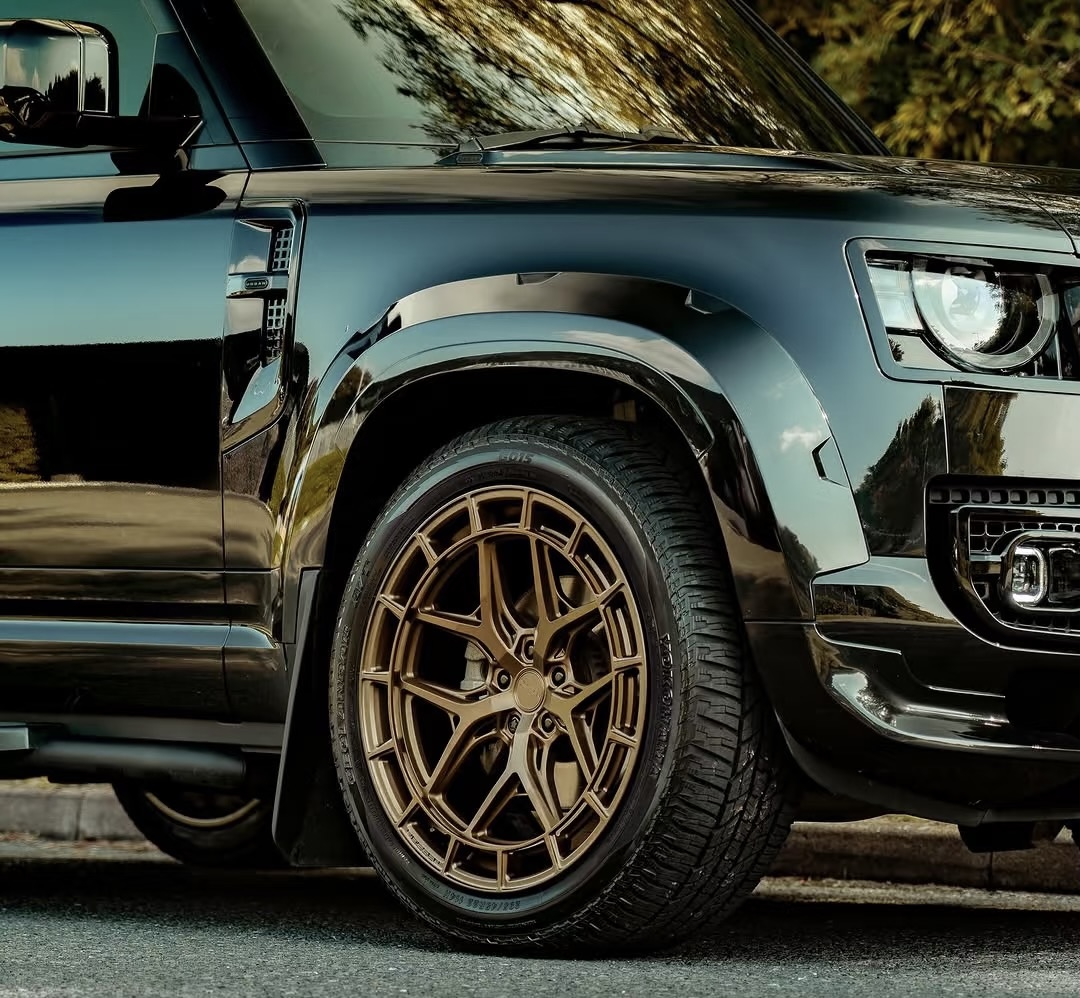
What Is Wheel Offset?
What Is Wheel Offset?
To understand wheel offset, imagine looking straight down at a wheel from above, as if it were sliced in half vertically.
Definition for Featured Snippet: > Wheel offset is the distance (measured in millimeters) from the exact centerline of the wheel to the mounting pad—the flat surface where the wheel bolts to the vehicle’s hub assembly. Offset determines how far inward or outward a wheel will sit inside the vehicle’s fender well.
Offset is divided into three distinct categories: positive, negative, and zero.
    [ STREET SIDE ]                   [ BRAKE SIDE ]

    +-----------------|-----------------+
    |                 |                 |
    |    Positive     |    Negative     |
    |     Offset      |     Offset      |
    |                 |                 |
    |         <--- [Hub] --->           |
    |                 |                 |
    +-----------------|-----------------+
                 Centerline
                 (Zero Offset)
The Three Types of Wheel Offset Explained
Understanding how these three types alter your vehicle’s stance is the key to achieving the perfect fitment.
1. Positive Wheel Offset
A positive offset means the mounting surface is located toward the front (or street side) of the wheel’s centerline. Because the mounting pad is pushed outward, the rest of the wheel is pulled inward toward the brakes and suspension.
-
What does +35 offset mean on rims? A $+35\text{mm}$ offset means the mounting surface is exactly $35\text{mm}$ forward from the true center of the wheel.
-
Common Applications: Most modern front-wheel-drive (FWD) cars, crossovers, and stock factory vehicles use a positive offset to keep the wheels safely tucked inside the fender wells for aerodynamics and fuel efficiency.
2. Negative Wheel Offset
A negative offset means the mounting surface is set closer to the back (or brake side) of the wheel’s centerline. This pushes the entire body of the wheel outward away from the vehicle.
-
What does negative 44 offset mean? A $-44\text{mm}$ offset means the mounting surface sits $44\text{mm}$ behind the centerline. This creates a deep-dish rim design and pushes the wheel far out past the fenders.
-
Common Applications: Negative offset is highly popular on lifted trucks, off-road Jeeps, and classic muscle cars where a wide, muscular stance is desired.
3. Zero Wheel Offset
Zero offset means the mounting surface aligns perfectly with the exact geometric centerline of the wheel. The wheel is balanced evenly over the hub assembly.
Wheel Offset Quick Reference Table
| Offset Type | Position of Mounting Pad | Visual Effect on Vehicle | Typical Vehicles |
|---|---|---|---|
| Positive (+) | Closer to the street side (front) | Wheels are tucked into the fenders | FWD cars, modern SUVs, stock vehicles |
| Zero (0) | Exactly at the centerline | Balanced, flush with the fender | Some older trucks, classic RWD cars |
| Negative (-) | Closer to the brake side (back) | Deep-dish look; wheels stick out | Lifted trucks, off-road rigs, widebodies |
Offset vs. Backspacing: What is the Difference?
While shopping for rims, you will often hear “offset” and “backspacing” used in the same sentence. While they measure similar things, they do it from different reference points.
-
Offset measures the distance from the centerline to the mounting pad. It is always calculated in millimeters.
-
Backspace measures the distance from the innermost edge of the rim to the mounting pad. It is always calculated in inches.
Backspacing is critical because it tells you exactly how deep the wheel will travel into your wheel well. If a wheel has too much backspacing, it will hit your brake calipers, sway bars, or struts.
How Much Can You Safely Change Your Offset?
When upgrading to aftermarket wheels, staying as close to factory specifications as possible keeps your steering geometry performing as intended.
The 5mm Guideline
Expert Tip: Generally, with new wheels, you don’t want the new offset to be more than 5 millimeters different from the old factory offset.
If you deviate too far beyond this window without modifying your suspension, you run into serious clearance issues. This is especially true when your new wheels are wider than the originals, because both width and backspacing must be factored into the equation simultaneously.
The Impact of Using Wheel Spacers
Some drivers try to correct an incorrect positive offset or achieve a wider stance by installing bolt-on wheel spacers.
-
How much offset is 2 inches? Generally, 2-inch spacers add approximately $-50.8\text{mm}$ of offset to your setup.
-
The Math: Wheel spacers essentially reduce the distance from the wheel center to the hub assembly, so they subtract from your current offset. For example, if your aftermarket wheels have a $+45\text{mm}$ offset, and you bolt on a 2-inch ($50.8\text{mm}$) spacer, you are subtracting $50.8\text{mm}$ from the offset, resulting in a net offset of $-5.8\text{mm}$.
The Risks of Incorrect Wheel Offset
Can a wheel offset be too much? Absolutely. Pushing the limits of your vehicle’s physical dimensions without proper planning introduces major safety and performance risks.
Risks of Excessive Positive Offset
-
Suspension Interference: The inner edge of the wheel or tire can rub against shocks, struts, or steering linkages.
-
Brake Damage: The inside barrel of the wheel may scrape against the brake calipers.
-
Tire Failure: High-speed rubbing against sharp internal metal components can cause tire blowouts.
Risks of Excessive Negative Offset
-
Fender Rubbing: When turning the steering wheel or hitting bumps, the outer edge of the tire will catch on the plastic bumper liner or sheet metal fenders.
-
Accelerated Component Wear: Pushing the wheels far outward acts like a lever against your hub, putting massive extra stress on wheel bearings, ball joints, and tie rods.
-
Compromised Handling: Extreme negative offset alters the vehicle’s “scrub radius,” leading to heavy steering, tracking issues on the highway, and unpredictable braking stability.
How to Measure Your Current Wheel Offset
If you want to calculate your vehicle’s offset at home, you can do it with a tape measure, a straightedge, and a calculator.
-
Remove the Wheel: Place the wheel flat on the ground with the back side facing up.
-
Measure Total Width ($W$): Lay a straightedge across the outer lips of the wheel and measure the total width edge-to-edge.
-
Find the Centerline ($C$): Divide the total width by 2 ($C = \frac{W}{2}$).
-
Measure Backspacing ($B$): Measure from the flat mounting pad up to the bottom of your straightedge.
-
Calculate the Offset ($O$): Subtract the Centerline from the Backspacing ($O = B – C$). Convert the final number from inches to millimeters by multiplying by 25.4.
Frequently Asked Questions (FAQ)
Will a change in wheel offset void my vehicle warranty?
Modifying your wheels does not completely void your vehicle warranty, but under the Magnuson-Moss Warranty Act, if a dealership can prove that an extreme aftermarket offset directly caused a component failure (like premature wheel bearing wear), they can deny coverage for that specific repair.
What is a “scrub radius” and why does offset change it?
The scrub radius is the distance between the center of the tire’s contact patch and the line where the steering axis intersects the ground. Changing your offset alters where the tire contacts the ground, which can make the steering wheel feel much heavier or snap violently when hitting bumps.
How do I know what my factory wheel offset is?
Most original equipment manufacturer (OEM) wheels have their size and offset stamped directly on the back of the spokes or the inner barrel. Look for a series of numbers followed by letters like ET (e.g., ET45, which stands for a $+45\text{mm}$ offset).
Do wide-body kits require negative offset wheels?
Yes. If you install fender flares or a wide-body kit, keeping your factory positive-offset wheels will make the vehicle look awkward as the wheels remain sunken deep inside the new bodywork. A negative offset is necessary to push the tires outward flush with the new exterior lines.
Get the Perfect Fitment for Your Vehicle
Upgrading your vehicle with a fresh set of rims transforms how it looks and handles on the road, but getting the wheel offset correct is the single most important step in the planning process. By understanding the balance between your hub, your centerline, and your fenders, you avoid costly rubbing issues and keep your suspension running smoothly.
Don’t guess on your fitment and risk damaging your vehicle. If you’re ready to find a set of precision-engineered rims tailored exactly to your car or truck’s specifications, explore the premium inventory and expert fitment guides at ATK Wheels to confidently build your ride today.