
Custom Car Wheels: Choosing the Right Size, Fitment, Material, and Style
Custom Car Wheels: Choosing the Right Size, Fitment, Material, and Style
Upgrading to a set of custom car wheels is one of the most effective modifications you can make to your vehicle. Whether your goal is aggressive stance, crisp track handling, or replacing factory steel rims with stylish aluminum alloy wheels, aftermarket wheels instantly transform your ride’s aesthetics and driving dynamics.
However, selecting custom rims involves more than choosing an eye-catching spoke pattern or finish. Installing the wrong bolt pattern, incorrect wheel offset, or improper center bore can cause tire rubbing, erratic steering, accelerated suspension wear, or unsafe high-speed vibrations.
This deep dive breaks down manufacturing technologies, fitment math, weight dynamics, and maintenance essentials so you can choose the ideal setup with confidence.
1. Manufacturing Technologies: Cast vs. Flow-Formed vs. Forged Wheels
Not all aftermarket wheels are built the same way. The structural integrity, weight, and price of custom wheels depend directly on the manufacturing process used.
Cast Wheels (Gravity & Low-Pressure Casting)
Cast alloy wheels are produced by pouring molten aluminum into a pre-shaped mold.
-
Gravity Casting: Molten metal fills the mold using only gravity. It is cost-effective but prone to minor internal porosity.
-
Low-Pressure Casting: Molten aluminum is forced into the mold under positive pressure from below. This creates a denser structural matrix than gravity casting.
-
Best For: Daily commuters and budget-conscious builds looking for upgraded style over track-focused weight reduction.
Flow-Formed Wheels (Rotary Forged)
Flow-forming bridges the gap between casting and full forging. The wheel face is cast using low pressure, after which the wheel barrel is mounted onto a specialized machine that heats and spins it while hydraulic rollers stretch and compress the aluminum.
-
Structural Benefit: This process aligns the aluminum grain structure horizontally along the barrel, drastically increasing tensile strength.
-
Best For: Enthusiasts seeking lightweight performance wheels for spirited driving or casual track days without paying full forged prices.
Forged Wheels (1-Piece Monoblock & Multi-Piece)
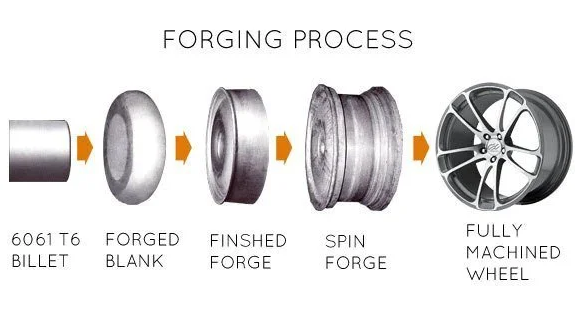
Forged wheels begin as solid blocks of aerospace-grade 6061-T6 aluminum billet. Under extreme hydraulic pressure (often 10,000 tons or higher), the metal block is crushed into shape before precise CNC machines carve out the final design.
-
Structural Benefit: Forging creates an ultra-dense grain structure free of internal air pockets. This allows engineers to use thinner spokes while maintaining high load ratings.
-
Variations: Available as 1-piece Monoblocks, 2-piece configurations, or 3-piece custom setups with step-lips and visible hardware.
-
Best For: Dedicated sports cars, track builds, luxury vehicles, and custom show cars demanding maximum strength-to-weight ratios.
Comparison Matrix: Wheel Manufacturing Methods
| Feature | Cast Wheels | Flow-Formed Wheels | Forged Wheels |
|---|---|---|---|
| Manufacturing Process | Molten aluminum poured into molds | Cast face + heat-rolled stretched barrel | CNC-machined solid aluminum billet under immense pressure |
| Relative Strength | Standard | High | Maximum |
| Weight | Heaviest | Moderate / Light | Extremely Lightweight |
| Impact Resistance | Fair (tends to crack on severe impact) | Good | Outstanding (tends to bend rather than shatter) |
| Price Point | Budget ($150 - $350 per wheel) | Mid-Range ($300 - $650 per wheel) | Premium ($800 - $2,500+ per wheel) |
| Primary Usage | Street driving, aesthetic upgrades | Autocross, performance street builds | Professional motorsports, supercars, custom builds |
2. Deciphering Wheel Fitment: 5 Specs You Cannot Ignore
Finding aftermarket wheels requires matching five key technical dimensions. Skipping even one measurement can prevent proper installation or damage your suspension.
Specification 1: Bolt Pattern (Pitch Circle Diameter – PCD)
The bolt pattern indicates how many lug holes the wheel has and the diameter of the imaginary circle they form.
-
Expressed as: Lug Count x Diameter in Millimeters (e.g.,
5x114.3or5x120). -
Crucial Note: A
5x112wheel will not mount on a vehicle hub measured for5x114.3without dangerous modification. Always match your hub pattern exactly.
Specification 2: Diameter & Width
Wheel dimensions are measured in inches across the inner tire seating bead.
-
Expressed as: 18×8.5J (18-inch diameter, 8.5-inch width).
-
Increasing diameter (e.g., upgrading from 17-inch to 19-inch wheels) requires selecting lower-profile tires to keep the total rolling diameter consistent.
Specification 3: Wheel Offset (ET) & Backspacing
Wheel offset represents the distance from the wheel’s mounting hub pad to its geometric centerline, measured in millimeters.
       [ OUTSIDE / FENDER ]                  [ INSIDE / SUSPENSION ]
                                Centerline
                                    |
            Negative Offset (<0) <--|--> Positive Offset (>0)
                                    |
                             [ Hub Mount Pad ]
-
Positive Offset (High ET): The mounting pad sits closer to the outer wheel face. This pulls the wheel inward toward the suspension struts (common on modern FWD and AWD cars).
-
Zero Offset (ET0): The mounting pad aligns directly with the wheel’s centerline.
-
Negative Offset (Low/Deep ET): The mounting pad sits inward toward the back of the wheel. This pushes the outer lip outward past the fender wall (common on classic muscle cars, wide-body kits, and off-road trucks).
-
Why Offset Matters: Incorrect offset can cause tires to scrub inner suspension struts or scrape outer fender lips during compression or full steering lock.
Specification 4: Center Bore & Hub-Centric Rings
The center bore is the machined hole behind the wheel hub center cap.
-
Hub-Centric Fitment: The wheel’s center bore matches the hub spindle diameter exactly (e.g., 66.6mm for Audi or 73.1mm aftermarket standard). Weight rests directly on the vehicle hub.
-
Lug-Centric Fitment: Aftermarket custom wheels often feature larger center bores to fit multiple vehicle makes. If a gap exists, you must install Hub-Centric Rings to eliminate high-speed steering vibration and prevent lug studs from bearing shear stress.
Specification 5: Brake Clearance (X-Factor / Caliper Clearance)
Brake clearance refers to the internal clearance between the backside of the wheel spokes and the outer edge of your brake calipers. Upgrading to big brake kits (BBK) requires high-disk wheel profiles that curve outward to provide clearance for larger multi-piston calipers.
3. How Custom Wheels Affect Driving Dynamics and Fuel Economy
Replacing factory wheels changes more than your car’s exterior appearance—it directly impacts unsprung mass and rotational inertia.
                                [ Vehicle Chassis ]
                                        |
                             ===== SUSPENSION ===== (Springs & Dampers)
                                        |
                 -----------------------------------------------+
                 |              UNSPRUNG MASS                   |
                 | (Brakes, Hubs, Custom Wheels & Tires Moving) |
                 -----------------------------------------------+
Understanding Unsprung Weight vs. Rotational Inertia
-
Unsprung Mass: Refers to all components not supported by your vehicle suspension springs (wheels, tires, brake rotors, bearings).
-
Rotational Inertia: Heavy wheels act as flywheels. The heavier the outer rim barrel is, the more engine power is lost attempting to rotate or stop that weight.
Performance Advantage: Dropping 5 lbs of unsprung weight per corner produces performance benefits comparable to removing approximately 80 lbs of interior cabin weight.
Impact on Acceleration, Braking & Steering Responsiveness
-
Lightweight Custom Wheels (Forged/Flow-Formed): Allow suspension shocks to react faster over road bumps, keeping tire tread firmly planted. Acceleration becomes noticeably sharper, brake distances shorten, and steering feel grows precise.
-
Oversized & Heavy Wheels (Low-Quality Cast): Add unwanted rotational mass, sluggish throttle response, increased brake fade under heavy load, and slightly reduced miles per gallon (MPG).
4. Maintenance and Care for Custom Wheel Finishes
Investing in quality wheels requires proper cleaning techniques to preserve clear coats, anodized colors, and polished lips over years of exposure to brake dust and road salt.
-
Avoid Acidic Cleaners: Never use aggressive acid-based cleaners on polished, painted, or powder-coated surfaces. Use pH-neutral wheel cleansers.
-
Cool Down Before Washing: Never spray cold water onto hot wheels immediately after driving. Thermal shock can warp brake rotors or crack delicate clear coatings.
-
Brake Dust Management: Hot metallic particles from brake pads pit raw aluminum. Clean wheels bi-weekly and apply dedicated ceramic coatings or synthetic sealant waxes to make cleaning easier.
-
Winter Protection: If you live in regions using road salt or liquid de-icers, store delicate custom multi-piece or polished wheels during winter months and use dedicated winter wheels.
Frequently Asked Questions
1. What is the difference between cast, flow-formed, and forged custom wheels?
Cast wheels are produced by pouring molten aluminum into molds, making them affordable but heavier. Flow-formed wheels feature cast faces with heat-rolled barrels for increased strength and lower weight. Forged wheels are machined from solid billet aluminum under high pressure, offering maximum structural strength and minimal weight at a premium cost.
2. How do I know what custom wheel size will fit my car?
Confirm five critical specs: bolt pattern (PCD), rim diameter and width, wheel offset (ET), center bore diameter, and brake caliper clearance. Check your factory owner manual, existing wheel markings, or consult a professional vehicle fitment database before ordering.
3. What is wheel offset and why does it matter?
Wheel offset (ET) measures the distance from the wheel hub mounting pad to its true centerline in millimeters. Correct offset ensures your wheels sit flush with fenders without contacting suspension struts, brake calipers, or inner fender wells.
4. Do custom wheels affect driving performance and fuel economy?
Yes. Switching to lightweight flow-formed or forged wheels reduces unsprung mass, improving acceleration, braking, handling, and fuel economy. Installing oversized or heavy wheels increases rotational inertia, leading to slower acceleration and increased fuel usage.
5. Do I need hub-centric rings when installing custom aftermarket wheels?
Yes, if the custom wheel’s center bore is larger than your vehicle hub spindle. Hub-centric rings fill the physical gap between the hub and center bore, centering the wheel precisely on the axle to eliminate steering wheel vibration at highway speeds.
Final Thoughts: Upgrade Your Vehicle’s Stance and Performance
Investing in custom car wheels is one of the most rewarding upgrades for any driver. By selecting the ideal manufacturing technology, measuring specs accurately, and pairing your rims with high-performance tires, you achieve a striking balance of elevated style and crisp vehicle control.

