
Automobile Wheels: Materials, Sizes, Performance, and Smart Buying Considerations
Automobile Wheels: Materials, Sizes, Performance, and Smart Buying Considerations
Every mile your vehicle travels depends on a small contact patch on the pavement. Holding those tires secure and converting engine torque into forward momentum are your automobile wheels. Beyond adding a distinct visual style to a sedan, truck, or SUV, automobile wheels directly dictate vehicle dynamics, braking distance, fuel efficiency, and structural safety.
Choosing aftermarket automobile wheels or replacing OEM units requires more than just picking a design you like. Installing an improper offset or incorrect bolt pattern can trigger severe hub clearance issues, premature bearing wear, or sudden tire rubbing against suspension components.
This breakdown covers essential engineering aspects, construction materials, technical measurement parameters, and maintenance routines to ensure optimal wheel selection.
1. Terminology Clarification: Automobile Wheels vs. Rims vs. Hubs
Automotive terms are often mixed up in casual conversation, especially when referring to automobile wheels and rims. While many drivers use these terms interchangeably, they represent distinct structural elements of a complete wheel assembly.
The Structural Breakdowns
-
The Rim: The outer circular lip of the wheel that secures and seals the rubber tire bead. It holds air pressure inside tubeless tire setups.
-
The Hub: The central section featuring bolt holes. It mounts directly over the wheel bearings and vehicle axle.
-
The Spokes: The structural bridges connecting the central hub to the outer rim. They distribute vehicle weight, absorb cornering loads, and facilitate brake cooling airflow.
-
The Complete Wheel: The entire single-piece or multi-piece metal structure consisting of the hub, spokes, and rim together.
Featured Snippet Direct Answer:What is the difference between automobile wheels and rims?The rim is simply the outer edge of a wheel that holds the tire in place, whereas the automobile wheel refers to the entire metal assembly, including the central hub, spokes, and outer rim.

2. Construction Materials and Manufacturing Methods
The raw material and manufacturing process dictate a wheel’s structural strength, impact resistance, overall weight, and price tag. Modern automobile wheels are primarily made from three materials, processed through specific engineering techniques.
Material Overview
-
Steel: Fabricated by stamping carbon steel and welding the rim barrel to the center plate. Steel wheels are extremely tough and cost-effective, though visually basic and heavy.
-
Aluminum Alloy: Formed by blending aluminum with silicon or nickel. Alloy wheels balance light weight, heat dissipation, and versatile structural designs.
-
Carbon Fiber: Crafted from high-density woven carbon fibers bound in specialized resin systems. Carbon fiber delivers extreme weight savings for high-performance supercars and racing setups, though at a premium cost.
Manufacturing Processes: Cast vs. Flow-Formed vs. Forged
How an alloy wheel is manufactured dictates its internal grain density and resistance to road impacts.
[Cast Aluminum]  --> Poured liquid metal (Higher weight, budget-friendly)
[Flow-Formed]   --> Cast center + heat-stretched barrel (Balanced strength & weight)
[Forged Alloy]   --> Solid billet crushed under extreme force (Maximum strength, minimum weight)
-
Gravity & Low-Pressure Casting: Liquid aluminum is poured into a mold. While cost-effective, cast wheels require thicker material to achieve safety thresholds, increasing total mass.
-
Flow Forming: Starts as a specialized low-pressure cast wheel. The outer barrel is heated and spun while high-pressure rollers compress and stretch the aluminum. This aligns the internal grain structure, significantly boosting tensile strength while trimming barrel weight.
-
Precision Forging: Solid billets of 6061-T6 aluminum are subjected to massive hydraulic press forces (often exceeding 8,000 tons). Forging eliminates internal porosity, enabling ultra-thin spoke designs with unmatched structural integrity.
Comprehensive Wheel Material & Manufacturing Comparison
| Specification / Attribute | Stamped Steel | Cast Aluminum Alloy | Flow-Formed Alloy | Forged Aluminum | Carbon Fiber |
|---|---|---|---|---|---|
| Primary Material Composition | Carbon steel plate & rim | Aluminum-silicon alloy | Aluminum alloy (compressed) | 6061-T6 Aluminum billet | Woven carbon fibers & resin |
| Manufacturing Process | Stamping & seam welding | Gravity or low-pressure casting | Cast core with heat-rolled barrel | High-tonnage hydraulic forging | High-pressure autoclave molding |
| Relative Weight | Heavy (Baseline reference) | Moderate (~20% lighter than steel) | Light (~30% lighter than cast) | Ultra-light (~40% lighter than cast) | Featherweight (~50%+ lighter than alloy) |
| Structural Integrity & Strength | Bends easily on harsh impact | Moderate strength (can crack under severe stress) | High tensile strength and elasticity | Exceptional structural density | Extreme rigidity (brittle under sheer impact) |
| Impact Repairability | High (Can be hammered/bent back) | Low to Moderate (Requires specialized welding) | Moderate (Requires precise heating) | High resilience (Less prone to deformation) | Non-repairable (Requires complete replacement) |
| Heat Dissipation Efficiency | Poor | High | High | Superior | Moderate |
| Unsprung Mass Reduction Impact | Minimal | Moderate improvement | Significant improvement | Maximum performance boost | Elite track-level performance boost |
| Typical Price Tier | Budget | Entry-Level/Mid-Tier/Premium/Ultra-Premium | |||
| Optimal Application | Winter tires, fleet vehicles, spare wheels | Daily commuter sedans, standard crossovers | Performance sedans, tuned street cars | Track-focused cars, luxury sports vehicles, heavy trucks | Supercars, competitive racing setups |
3. Essential Fitment Parameters Before Buying
Selecting aftermarket automobile wheels requires double-checking exact technical measurements. Deviating from factory tolerances can lead to suspension damage, speedometer errors, or unsafe handling.
The Five Core Specifications
-
Bolt Pattern (PCD – Pitch Circle Diameter): Expressed as the number of lug holes multiplied by the diameter of the imaginary circle they form (e.g.,
5x114.3or5x120). The lug pattern must match your wheel hub’s stud arrangement precisely. -
Wheel Diameter & Width: Measured across the tire seating surface in inches (e.g.,
18x8.5J). Width dictates the appropriate tire profile, while overall diameter affects ground clearance and speedometer calibration. -
Offset (ET): The distance in millimeters from the wheel’s true centerline to the mounting hub surface.
-
Positive Offset (+ET): The hub mounting surface sits closer to the outer face of the wheel (common on modern front-wheel-drive vehicles).
-
Zero Offset (ET0): The hub mounting surface aligns exactly with the wheel centerline.
-
Negative Offset (-ET): The hub mounting surface sits toward the brake side, pushing the wheel outward for a wide stance (popular on lifted trucks and off-road vehicles).
-
-
Hub Center Bore: The central opening on the back of the wheel measured in millimeters (e.g.,
73.1mm). It must fit snugly over the vehicle’s hub snout. If the aftermarket bore is larger than the vehicle’s hub, hub-centric rings are required to eliminate high-speed vibrations. -
Load Rating: The maximum structural weight capacity a single wheel can safely support. Heavy-duty trucks and electric vehicles (EVs) require significantly higher load ratings due to higher curb weights and instantaneous torque delivery.
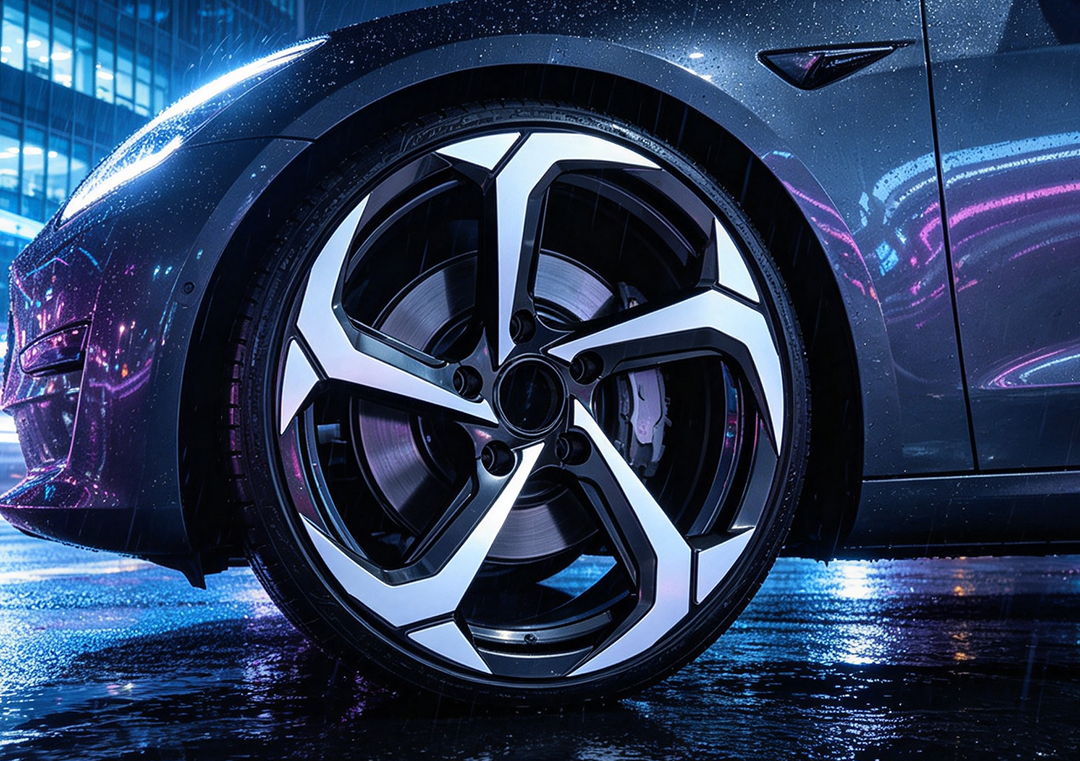
4. Vehicle Dynamics: How Wheel Weight Impacts Driving
The weight of your automobile wheels directly influences two fundamental physics concepts: Unsprung Mass and Rotational Inertia.
Understanding Unsprung Mass
Unsprung mass includes all vehicle components not supported by the suspension springs—such as tires, brake rotors, wheel bearings, and the wheels themselves.
$$\text{Total Unsprung Weight} = \text{Tires} + \text{Automobile Wheels} + \text{Braking Assemblies} + \text{Lower Suspension Arms}$$
Reducing unsprung mass helps the suspension damp shock loads far faster over bumpy roads. This keeps the tire tread planted firmly on the asphalt, boosting mechanical grip.
[ Lighter Wheels ]
       │
       ├──► Lower Rotational Inertia ──► Faster Acceleration & Shorter Braking
       │
       └──► Reduced Unsprung Mass  ──► Suspension Reacts Faster to Bumps
Benefits of Upgrading to Lightweight Wheels
-
Sharper Acceleration: Lowering rotational mass lets the engine spin the drivetrain up to speed with less power loss.
-
Shorter Braking Distances: Less kinetic energy stored in spinning wheels reduces the thermal workload on brake pads and rotors.
-
Better Fuel Economy & Range: Dropping mass at the corners reduces energy consumption in city driving, benefiting both gas-powered cars and range-sensitive EVs.
-
Enhanced Steering Feel: Lighter wheels lower gyroscopic resistance, making steering input feel sharper and more communicative during quick directional changes.
5. Maintenance Best Practices, Balancing, and Alignment
Proper upkeep preserves both the structural integrity and aesthetic finish of your automobile wheels over years of driving.
Balancing vs. Alignment
Drivers frequently confuse wheel balancing with wheel alignment services. Both are necessary to prevent uneven tire wear and steering wheel vibration, but they address entirely different issues.
-
Wheel Balancing: Equalizes weight distribution across the entire wheel and tire assembly using small clip-on or adhesive weights to eliminate dynamic wobble at highway speeds.
-
Wheel Alignment: Adjusts physical suspension angles relative to the chassis frame (specifically Camber, Toe, and Caster) to ensure tires roll straight and make even contact with the road surface.
Care and Protective Measures
-
Cleaning Routine: Avoid harsh acid-based cleaners that can etch clear coat finishes or pit bare aluminum. Use pH-balanced automotive shampoos with microfiber washing mitts.
-
Torque Check: Always tighten lug nuts in a star pattern using a calibrated torque wrench to the manufacturer’s specified foot-pounds (
ft-lbs). Over-tightening can warp brake rotors or stretch wheel studs. -
Corrosion Prevention: In cold climates where road salt is used, apply a sealant or ceramic coating to protect metal surfaces against pitting and clear-coat failure.

Frequently Asked Questions(FAQ)
1.What is the difference between automobile wheels and rims?
The rim is simply the outer edge of a wheel that holds the tire in place, whereas the automobile wheel refers to the entire metal assembly, including the central hub, spokes, and outer rim.
2.What are the primary types of materials used in automobile wheels?
Automobile wheels are mainly made from three materials:
-
Steel: High durability and low cost, but heavier.
-
Aluminum Alloy: Lightweight, superior heat dissipation, and versatile aesthetic designs.
-
Carbon Fiber: Extremely lightweight for high-performance vehicles, but costly.
3.What specifications must be checked before buying aftermarket automobile wheels?
You must verify five core parameters:
-
Bolt Pattern (PCD): Number of lug holes and circle diameter.
-
Wheel Diameter & Width: Physical dimensions for tire compatibility.
-
Offset (ET): Distance from the mounting surface to the wheel centerline.
-
Hub Center Bore: Size of the center hole fitting the vehicle’s axle.
-
Load Rating: Weight capacity per wheel.
4.How do automobile wheels affect vehicle performance and handling?
Wheel weight directly affects unsprung mass. Lighter wheels (such as alloy or forged aluminum) reduce rotational inertia, enhancing acceleration, braking efficiency, fuel economy, and suspension responsiveness.
5.What is the difference between wheel balancing and wheel alignment?
-
Wheel Balancing: Corrects weight distribution around the wheel and tire assembly using small weights to prevent vibration at speed.
-
Wheel Alignment: Adjusts the suspension angles (camber, toe, caster) so the tires contact the road evenly and travel in a straight direction.
Upgrade Your Ride Today
Selecting the right set of automobile wheels transforms your vehicle’s appearance, road feedback, and overall handling performance. Whether you’re upgrading to lightweight forged alloys for track days, mounting durable steel wheels for winter driving, or replacing OEM units, keeping fitment specs aligned is essential.
Check your vehicle’s factory specifications, confirm your target load rating, and explore precision-engineered automobile wheels tailored to your vehicle’s exact make and model.

