
Auto Wheels: Everything You Need to Know About Types, Sizing, and Performance Fitment
Auto Wheels: Everything You Need to Know About Types, Sizing, and Performance Fitment
Auto wheels serve as the direct link between a vehicle’s suspension system and the road surface, influencing everything from fuel efficiency and steering response to braking performance and stance. Whether replacing damaged stock rims, upgrading to lightweight aftermarket performance wheels, or selecting a secondary winter setup, understanding wheel construction, dimensional specifications, and fitment parameters ensures optimal safety and driving dynamics.
1.What Are Auto Wheels?
Auto wheels are engineered structural assemblies mounted directly to a vehicle’s axle hubs to sustain vehicular weight, transfer rotational torque from the powertrain, and lock pneumatic tires into position under heavy cornering loads. While tires provide the flexible rubber tread interface necessary for surface friction, auto wheels comprise the rigid structural core typically fabricated from high-strength steel, cast aluminum, flow-formed alloys, or lightweight forged aerospace metals.
                  [ Outer Rim Lip ]
                         |
      +------------------+------------------+
      |  Outer Barrel    |    Inner Barrel  |  <-- Rim Barrel Width
      +------+-----------+-----------+------+
             |   Spoke Area          |
             |   (Center Disc)       |
             +--------+  +-----------+
                      |  |
                      |  |  <-- Hub Mounting Surface
                      +--+
                       ^
                       |
               [ Center Bore ]
An auto wheel consists of specific anatomical regions that directly dictate strength, tire bead seat integrity, and clearance:
-
The Rim Barrel: The outer cylindrical boundary extending between the inner and outer rim lips. It creates an airtight sealing surface for the tire beads to maintain consistent cold inflation pressures under violent acceleration and dynamic lateral cornering g-forces.
-
The Center Disc (Hub Face): The primary mounting zone featuring precision-machined bolt holes, center bore aperture, and radiating structural spokes designed to disperse road vibrations and suspension shocks.
-
The Bead Seat & Safety Humps: Specially contoured ridges inside the inner channel that lock tire bead bundles in place, preventing dislodgement during low-pressure operation or hard cornering maneuvers.
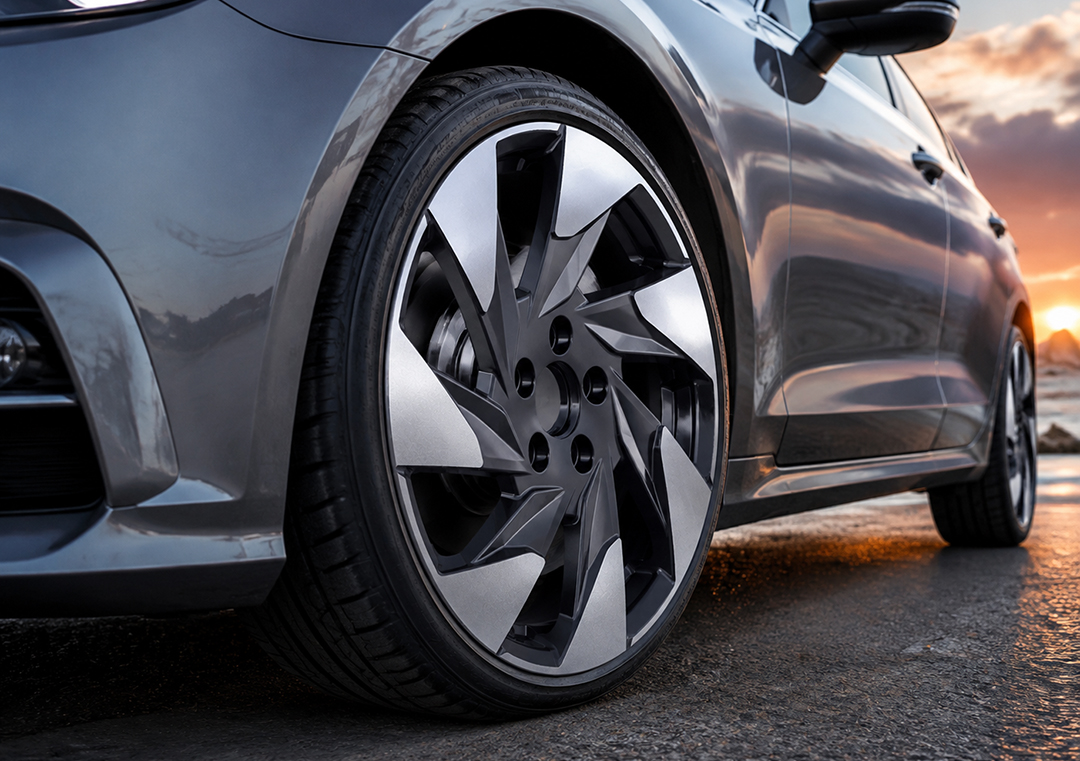
2.Auto Wheel Materials: Steel vs. Cast Alloy vs. Forged Alloy vs. Carbon Fiber
Selecting appropriate auto wheels requires balancing structural rigidity, rotational mass, impact tolerance, aesthetic requirements, and financial investment.
1. Steel Auto Wheels
Stamped from heavy-duty low-carbon steel plate and perimeter welded, steel wheels represent the baseline standard for utility, commercial transport, and extreme cold-weather operations.
-
Engineering Advantages: Exceptional impact resilience, highly resistant to catastrophic stress fractures, easy to cold-hammer back into roundness if bent by potholes, extremely low purchase price.
-
Performance Drawbacks: Substantial unsprung weight, accelerated suspension bushing wear, reduced dampening efficiency over irregular terrain, limited aesthetic variations, high susceptibility to surface rust if paint coatings wear off.
2. Cast Aluminum Alloy Auto Wheels
Cast aluminum auto wheels dominate both original equipment manufacturer (OEM) assembly lines and general consumer aftermarket catalog options. Liquid aluminum alloy is poured or vacuum-sucked into specialized metallic molds.
-
Gravity Casting: Molten alloy pours into molds purely under gravitational pull. Economical, but requires extra wall thickness to eliminate air pockets, adding unnecessary mass.
-
Low-Pressure Casting: Liquid alloy is forced upward into molds under controlled hydraulic pressure. Reduces internal porosity, yielding denser material structures that allow thinner, lighter spoke geometries.
3. Flow-Formed Auto Wheels
Flow-forming (also styled as rotary forged or rim-formed) represents an intermediate manufacturing breakthrough bridging cast efficiency and forged strength. Cast wheel blanks are placed on CNC mandates, heated, and spun rapidly while hydraulic rollers stretch and compress the aluminum wheel barrel material.
-
Engineering Advantages: Realizes crystalline aluminum grain structures nearly identical to fully forged wheels within the critical outer barrel region, drastically reducing rotational weight while increasing tensile strength by up to 20% over standard low-pressure cast wheels.
4. Fully Forged Aluminum Auto Wheels
Forged wheels begin as solid billets of aerospace-grade 6061-T6 aluminum. Massive industrial presses apply tens of thousands of tons of pressure to compress the metal into raw wheel blanks before high-precision multi-axis CNC machines carve intricate spoke profiles and weight-reduction pockets.
-
Engineering Advantages: Highest strength-to-weight ratio available in metals, exceptional fatigue life, maximum flex resistance under severe track conditions, ability to bend slightly under extreme shock impacts rather than shattering instantly.
-
Performance Drawbacks: Extremely labor-intensive manufacturing processes yield steep retail price points.
5. Carbon Fiber Composites
Carbon fiber auto wheels utilize resin-infused multi-axial woven carbon filaments formed within high-pressure autoclaves, often paired with lightweight aluminum centers in hybrid configurations.
-
Engineering Advantages: Unmatched light weight, radical reduction in rotational moment of inertia, near-zero flexing during high-g cornering.
-
Performance Drawbacks: Ultra-premium cost structure, vulnerability to catastrophic delamination from impact strikes, zero thermal tolerance for bent repairs.
Architectural Matrix: Auto Wheel Manufacturing Standards
| Parameter / Feature | Stamped Steel | Gravity/Low-Pressure Cast | Flow-Formed Alloy | Fully Forged Alloy | Carbon Fiber Composite |
|---|---|---|---|---|---|
| Rotational Mass | Very High | Moderate to High | Low-Moderate | Extremely Low | Minimal |
| Tensile Strength | Moderate | Standard | Enhanced | Maximum | Ultra-Rigid |
| Impact Response | Bends / Repairable | Cracks / Fractures | Yields / Bends | Resists / Yields | Shatters / Scraps |
| Heat Dissipation | Poor | Good | Excellent | Superior | Insulated Thermal Base |
| Price Tier | Economy | Budget-Mid/Performance/Luxury/Exotic | |||
| Primary Utility | Winter / Fleet | Daily Commute | Street / Track | Motorsport / Luxury | High-End Hypercars |
3.Detailed Sizing Parameters for Auto Wheels
Installing aftermarket auto wheels requires strict adherence to dimensional metrics. Deviating from original factory parameters risks suspension damage, bodywork contact, reduced brake clearance, and unpredictable emergency handling characteristics.
1. Overall Diameter and Rim Width
Wheel dimensions follow standard industrial nomenclature formatted as
19 x 9.5J.-
19 (Diameter): Indicates the 19-inch nominal seating diameter where the tire bead locks onto the inner rim ledge.
-
9.5 (Width): Represents the 9.5-inch distance measured internally between the inner surfaces of the front and rear rim flanges (not the outer total dimension of the rim lips).
-
J (Flange Profile): Refers to the specific geometric contour profile of the rim lip (standard for most passenger cars).
2. Pitch Circle Diameter (PCD) / Bolt Pattern
PCD designates the structural layout of mounting bolt holes on the center hub face. It includes two critical values: the bolt count and the diameter of the imaginary circle passing through the center of every lug aperture.
-
4-Lug Patterns: Measured directly across opposing holes (e.g.,
4x100mm). -
5-Lug Patterns: Measured from the back edge of one hole to the center of the second non-adjacent hole (e.g.,
5x114.3mm/5x4.5 inches,5x120mm). -
6/8-Lug Patterns: Commonly utilized on heavy trucks and heavy-duty off-road platforms (e.g.,
6x139.7mm/6x5.5 inches,8x165.1mm).
3. Wheel Offset (ET) and Backspacing
Wheel offset—derived from the German word Einpresstiefe and abbreviated as ET—is the measured distance in millimeters between the geometric centerline of the wheel barrel and the flat metal surface that mounts flush against the brake hat/hub face.
       [ Positive Offset (+ET) ]            [ Zero Offset (0) ]            [ Negative Offset (-ET) ]
            Wheel Center                         Wheel Center                     Wheel Center
                 |                                    |                                |
        +--------+--------+                  +--------+--------+              +--------+--------+
        |        |        |                  |        |        |              |        |        |
        |      |===|      |                  |      |===|      |              |      |===|      |
        |      |===|      |                  |      |===|      |              |      |===|      |
        +--------+--------+                  +--------+--------+              +--------+--------+
                 |                                    |                                |
           Mounting Surface                     Mounting Surface                 Mounting Surface
           Tucked Inward                          Centered Face                    Pushed Outward
-
Positive Offset (+ET): The hub mounting surface sits forward, toward the outer face of the wheel. Common on modern front-wheel-drive and modern all-wheel-drive vehicles. Excessively high positive offset pulls the wheel inward toward inner strut towers and sway bars.
-
Negative Offset (-ET): The hub mounting surface sits deep inside toward the rear barrel, pushing the spoke geometry far outward. Used on deep-dish muscle cars, classic sports cars, and lifted trucks requiring aggressive outer track widths.
-
Zero Offset (ET0): The mounting face sits flush with the exact mathematical center line of the wheel width.
-
Backspacing: The physical dimension (in inches) measured from the innermost rear rim edge back to the hub mounting face. Backspacing accounts for both offset and flange depth, offering off-road builders a quick check for frame rail clearance.
4. Center Bore Dimensions and Centricity
The center bore is the machined central pass-through opening on the backside of the wheel hub face.
-
Hub-Centric Design: The center bore precisely matches the lip on the vehicle’s axle hub snout (e.g.,
66.1mmor73.1mm). The vehicle hub carries the sheer weight of the vehicle, while the lug nuts simply clamp the wheel flush to the brake hat. -
Lug-Centric Design: The wheel bore is larger than the axle snout, relying entirely on tapered lug nuts/bolts to center the assembly. Without precision hub-centric centering rings made of heat-resistant polycarbonate or billet aluminum, lug-centric installations often suffer from persistent high-speed steering wheel oscillations.
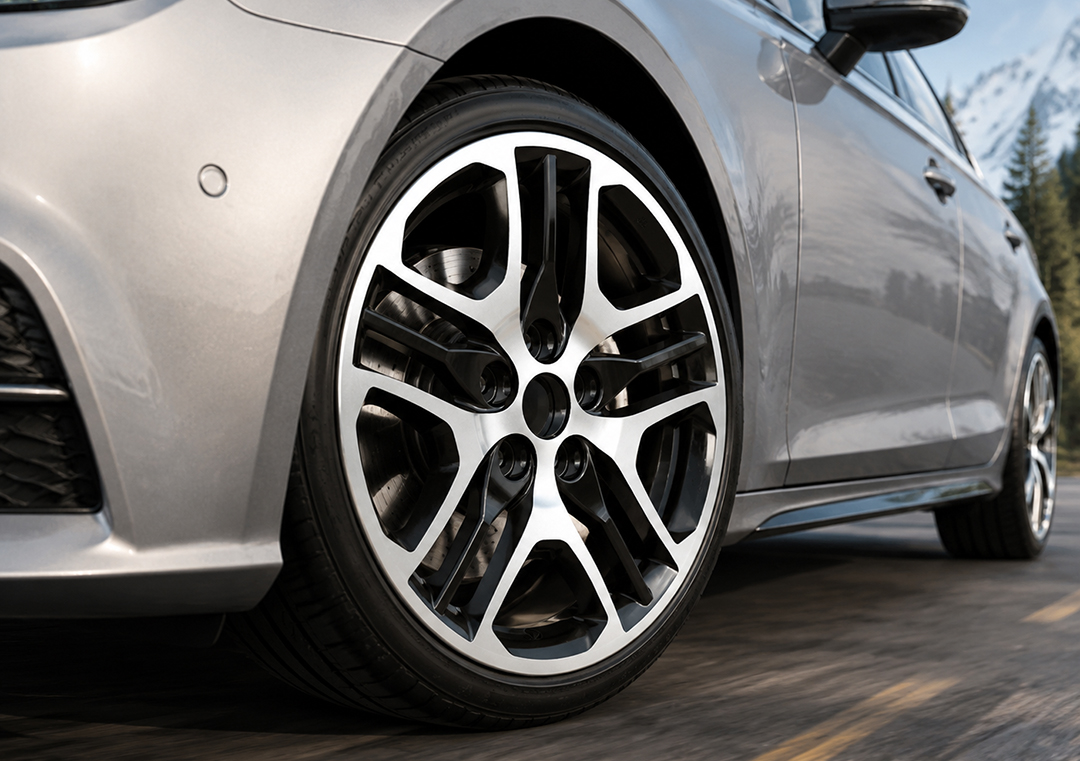
4.Performance Dynamics: How Unsprung Mass Transforms Handling
Upgrading auto wheels changes key physical mechanics beyond visual stance. The core performance variable affected by wheel weight is unsprung mass—components situated below the primary suspension damping springs (wheels, tires, brake calipers, rotors, and wheel bearings).
[ Vehicle Chassis / Sprung Mass ]
       |
  [ Suspension Spring / Shock ]
       |
================================  <-- Suspension Separation Line
       |
[ Auto Wheels + Tires + Brakes ]  <-- Unsprung Mass
-
Rotational Inertia Reduction: Lighter wheels lower rotational mass. Decreasing the angular momentum required to accelerate a rotating mass yields faster throttle acceleration response and reduced braking distances under heavy deceleration.
-
Suspension Velocity Tracking: When a vehicle hits bumps, the suspension spring compresses to keep the tire planted. Heavy steel wheels possess high inertia, causing shock absorbers to struggle to control rebound movements. Lightweight forged alloy wheels allow suspension components to react faster to road imperfections, maximizing tire contact patches over rough surfaces.
-
Gyroscopic Precession and Steering Effort: Lighter wheels decrease gyroscopic forces generated by fast-spinning assemblies. Lower gyroscopic resistance results in sharper turn-in precision, neutral steering feel, and reduced wear on power steering steering racks.
5.Step-by-Step Protocol to Verify Correct Auto Wheel Fitment
Before purchasing aftermarket auto wheels, perform this engineering fitment validation procedure:
[ Step 1: Check Door Jamb Sticker ]
                │
                ▼
[ Step 2: Confirm PCD & Center Bore ]
                │
                ▼
[ Step 3: Calculate Offset Delta ]
                │
                ▼
[ Step 4: Verify Caliper Spoke Clearance ]
                │
                ▼
[ Step 5: Check Wheel Load Capacity ]
-
Check Vehicle Identification Placards: Reference the driver’s B-pillar tire placard sticker and factory repair manuals to record base factory specs: wheel diameter, rim width, factory ET offset, tire profile, and baseline tire pressures.
-
Verify Bolt Circle and Hub Dimensions: Confirm the replacement wheel PCD matches your car’s hub exactly. If using aftermarket wheels with a broader center bore, procure hub-centric rings matching the car’s hub snout OD to the wheel’s bore ID.
-
Calculate Offset and Suspension Clearances: Calculate offset shifts carefully. Adding 1 inch of wheel width toward the inside reduces inner strut clearance by approximately 0.5 inches plus or minus the ET shift. Ensure at least
15mmof clearance from inner suspension struts, tie rods, and outer fender sheet metal. -
Confirm Brake Caliper Clearance (X-Factor): Spoke contouring determines internal brake clearance. Vehicles retrofitted with multi-piston Big Brake Kits (BBK) require curved outer spoke profiles or aggressive offset clearances to prevent spoke face scraping against outer caliper walls.
-
Verify Structural Load Ratings: Check the certified wheel load rating (often stamped on the rear hub face in kilograms or pounds). Ensure each wheel’s maximum load capacity meets or exceeds half of the vehicle’s heavily loaded Gross Axle Weight Rating (GAWR).
Frequently Asked Questions(FAQ)
1.What are auto wheels?
Auto wheels are engineered structural assemblies fitted to cars, SUVs, and trucks that mount securely to the vehicle’s axle hubs to support vehicular weight, transmit drive torque, and secure rubber tires in place.
2.How do I know what size auto wheels fit my car?
Check your vehicle’s owner manual or the tire specification sticker located inside the driver-side door jamb for factory wheel diameter, rim width, bolt pattern, and offset specs. Always verify brake caliper clearance and center bore sizing prior to purchase.
3.What is the difference between steel and alloy auto wheels?
Steel wheels are heavy, stamped components built for durability, structural impact tolerance, and budget winter setups. Alloy wheels are cast or forged from lightweight aluminum mixtures, offering improved heat dissipation, reduced unsprung mass, sharper handling, and a wide variety of styling choices.
4.Why are PCD and offset important when choosing auto wheels?
PCD must match the axle hub’s bolt pattern to allow secure mounting. Offset controls where the wheel sits within the wheel well; incorrect offset causes suspension rubbing, fender contact, premature wheel bearing wear, and dangerous scrub radius changes.
5.Can I install aftermarket auto wheels on my car?
Yes, aftermarket auto wheels can be installed if their diameter, width, PCD, center bore, offset, brake caliper clearance, and certified load capacity align with your chassis specifications.
Ready to Upgrade Your Vehicle’s Stance and Performance?
Selecting the right auto wheels requires balancing precision engineering with personal style. Whether you need durable steel rims for severe winter conditions or lightweight flow-formed alloy wheels for track days, working with verified fitment experts ensures a seamless installation.
Explore comprehensive fitment catalogs, calculate exact offset specs, and discover high-performance wheel collections tailored to your vehicle’s make and model today.

