
Custom Wheel Builder: How to Engineer Forged Wheels for Perfect Fitment & Peak Performance
Custom Wheel Builder: How to Engineer Forged Wheels for Perfect Fitment & Peak Performance
Finding the exact set of wheels to match your vehicle’s stance, performance metrics, and aesthetic vision often feels like hunting for a needle in a haystack. Off-the-shelf cast rims from big-box retailers come with rigid factory dimensions, conservative offsets, and mass-market styling that rarely delivers a flush fitment or accommodates aggressive aftermarket upgrades.
An online custom wheel builder bridges the gap between raw automotive design and real-world performance engineering. Whether you are fitting a widebody sports car, upgrading to a Big Brake Kit (BBK), or searching for lightweight forged wheels tailored to your exact bolt pattern, configuring a custom set ensures zero compromises on quality, safety, or style.
This detailed overview breaks down how interactive wheel builders function, the engineering principles behind custom forged manufacturing, and how to select every specification—from PCD to backspacing—for your vehicle.
1.What Is a Custom Wheel Builder and How Does It Work?
A custom wheel builder is an interactive online configurator and engineering portal that allows vehicle owners, tuners, and shop managers to design custom wheels tailored to exact automotive dimensions. Rather than settling for off-the-shelf factory inventory with generic fitments, an interactive builder gives you complete control over every dimensional and aesthetic parameter of the wheel construction process.
The Engineering Workflow Behind Custom Configuration
When you configure a set through a digital wheel builder, the platform transforms your input data into actionable CAD (Computer-Aided Design) blueprints. The software maps out five fundamental fitment vectors:
-
Vehicle Telemetry: Identifies the factory hub setup, axle load limits, fender depth, and brake caliper profile.
-
Structural Architecture: Selects the core wheel construction, choosing between a sleek 1-piece monoblock, 2-piece modular, or 3-piece deep-lip assembly.
-
Dimensional Scale: Defines the precise wheel diameter, rim width, and center bore size down to the millimeter.
-
Offset & Backspacing: Calculates the exact ET value to position the wheel flush with the fender line without scrubbing the inner liner.
-
Aesthetic Customization: Applies surface treatments including brush textures, polished lips, custom anodizing, and specialized powder coating.
Leading manufacturers like ATK Wheels leverage these exact CAD parameters to run Finite Element Analysis (FEA) simulations before a single block of aluminum touches a CNC mill. This guarantees that your custom-configured design handles real-world cornering loads, thermal expansion, and road impacts safely.
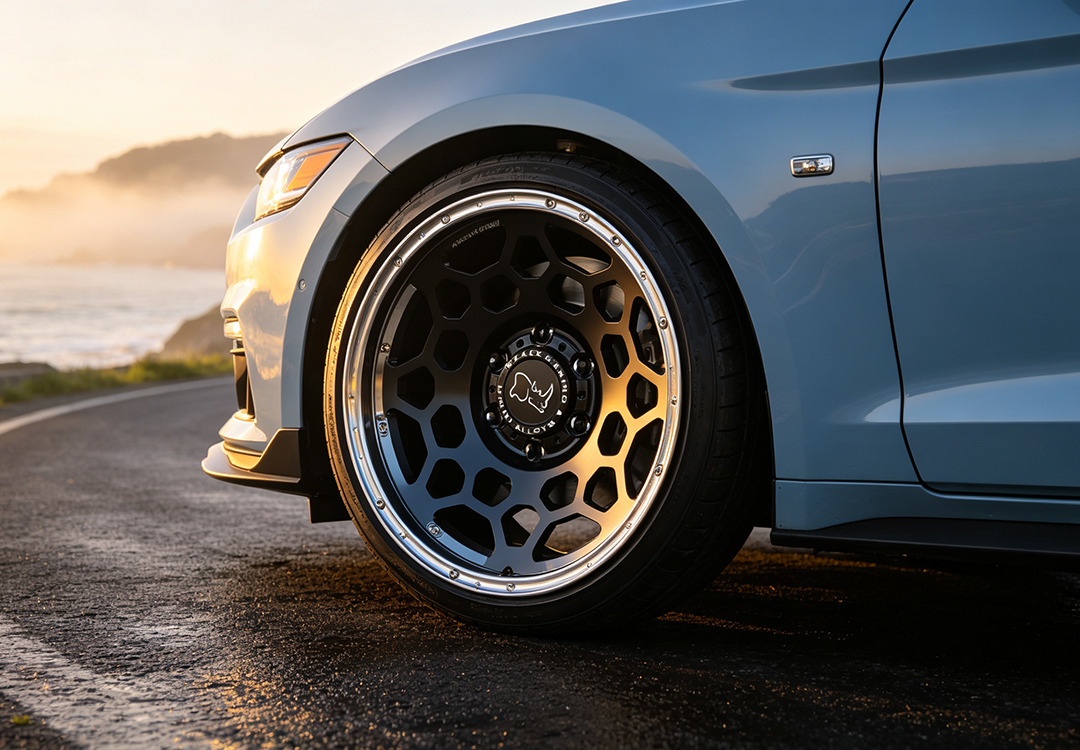
2.Custom Wheel Builder vs. Retail Wheel Distributor: Key Differences
Understanding the fundamental difference between ordering through a custom wheel builder and purchasing from a mass-market retail distributor comes down to tailored engineering versus mass production.
Retail distributors stock pre-manufactured cast or flow-formed wheels produced in high-volume production runs. These wheels use universal offsets, standard bolt patterns, and conservative center bores intended to fit as many car models as possible. Consequently, drivers often need hub-centric rings, wheel spacers, or rolled fenders to achieve a decent stance.
A custom wheel manufacturer engineers each wheel block individually based on the specific telemetry of your hub, suspension clearance, and brake assembly.
| Feature / Metric | Custom Wheel Builder (e.g., ATK Wheels) | Retail Wheel Distributor |
|---|---|---|
| Manufacturing Method | 100% Precision CNC Machined Forged Aluminum | High-Volume Cast or Flow-Formed Production |
| Fitment Accuracy | Direct Hub-Centric Fitment (Exact PCD, Bore, Offset) | Universal Bolt Patterns with Adapter Rings/Spacers |
| Brake Clearance | Custom X-Factor Engineered for Big Brake Kits (BBK) | Generic Caliper Clearance (Risk of Rubbing) |
| Structural Integrity | Aerospace 6061-T6 Forged Billet (High Density) | Cast Aluminum Alloy (Lower Density, Heavier) |
| Finishing Options | Unlimited Hand-Brushed, Polished, & Custom Coatings | Limited Stock Colors (Gloss Black, Silver, Gunmetal) |
| Lead Time | 3 to 8 Weeks (Built-to-Order Precision) | Immediate In-Stock Shipping (Generic Sizes) |
| Weight-to-Strength Ratio | Maximum Strength with Reduced Rotary Mass | Heavier Structural Mass Needed for Load Ratings |
3.Why 6061-T6 Forged Aluminum Is the Gold Standard
The material selected inside a custom wheel builder directly dictates the wheel’s fatigue life, structural strength, and overall unsprung weight. While budget retailers sell cast aluminum wheels—made by pouring molten metal into molds—custom forged wheel builders use aerospace-grade 6061-T6 aluminum billets.
The Physics of Forging: Heat, Pressure, and Grain Alignment
-
Extreme Mechanical Compression: A solid cylinder of 6061 aluminum is subjected to thousands of tons of hydraulic pressure. This intense force collapses internal micro-voids, eliminates air porosity, and realigns the metal’s crystalline grain structure along the contours of the wheel profile.
-
T6 Thermal Tempering: After initial forging, the aluminum undergoes a multi-stage heat-treatment process (solution heat treating and artificial aging) to reach its maximum yield strength and tensile rating.
-
Unsprung Weight Reduction: Because forged 6061-T6 aluminum possesses significantly higher tensile strength than cast alloy, engineers use thinner spoke profiles and lightened barrel walls without sacrificing load capacity.
By minimizing unsprung rotational weight at all four corners of your vehicle, forged wheels drastically improve acceleration response, shorten braking distances, and allow your suspension to react faster to sudden surface irregularities.
4.Anatomy of Custom Wheel Architecture: Monoblock vs. Modular 2-Piece & 3-Piece
When utilizing a custom wheel configurator, selecting the appropriate structural setup is a critical decision. Each wheel construction style delivers distinct advantages regarding strength, weight, lip depth, and repairability.
1-Piece Monoblock Forged Wheels
Monoblock wheels are carved from a single continuous block of forged 6061-T6 aluminum using multi-axis CNC machines.
-
Key Advantages: Unmatched structural rigidity, minimal rotational weight, exceptional structural balance, and simple maintenance.
-
Ideal For: Track vehicles, daily performance drivers, and sports cars where weight reduction and dynamic handling take top priority.
2-Piece Modular Forged Wheels
Two-piece construction consists of an individually forged center face bolted or welded into a separate forged outer barrel.
-
Key Advantages: Allows tailored offset adjustments, distinct color contrasting between the face and lip, and easier lip replacement if damaged.
-
Ideal For: Luxury sedans, performance coupes, and custom vehicle builds requiring specialized offsets.
3-Piece Modular Forged Wheels
Three-piece setups combine an inner barrel, an outer lip, and a forged center face, held together by high-strength assembly hardware and sealed with an industrial perimeter gasket.
-
Key Advantages: Unlocks extreme deep-lip designs, ultra-wide fitments, fully customizable hardware finishes, and individual component serviceability.
-
Ideal For: Widebody supercar transformations, aggressive stance builds, and classic restorations requiring bespoke backspacing.
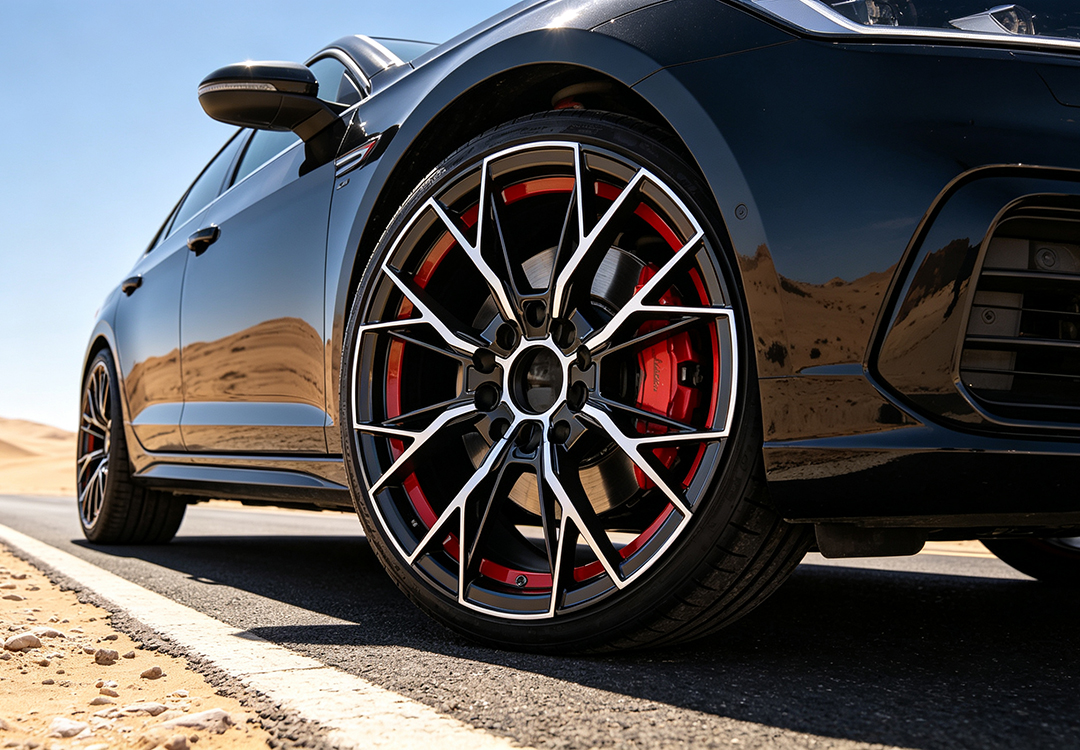
5.Critical Fitment Parameters You Must Know Before Configuring
To maximize the output of an interactive custom wheel builder, you must understand the key technical measurements that dictate proper wheel clearance. Engineering a direct bolt-on setup requires balancing four core fitment specifications:
1. Bolt Pattern (PCD – Pitch Circle Diameter)
PCD indicates the number of lug holes and the diameter of the imaginary circle they form (e.g.,
5x112, 5x120, 5x130). Custom wheel manufacturing machines lug pockets precisely to match your vehicle’s factory hub studs or wheel bolts, eliminating the need for unsafe eccentric lug nuts or wobble bolts.2. Center Bore (CB)
The center bore is the machined opening on the back of the wheel center that aligns perfectly onto the vehicle’s axle hub snout. A true custom forged wheel features a hub-centric bore cut to the exact fraction of a millimeter (e.g.,
66.6mm or 72.6mm), ensuring zero high-speed vibration without resorting to plastic or aluminum hub-centric adapter rings.3. ET Offset and Backspacing
-
Offset (ET): The distance in millimeters from the wheel’s true structural centerline to its mounting hub surface. A positive offset moves the wheel face outward toward the street, while a negative offset creates a deep dish profile by pushing the wheel center inward toward the brakes.
-
Backspacing: Measured from the backside edge of the rim flange to the hub mounting face. Accurate backspacing calculations prevent the inner wheel lip from making contact with struts, control arms, or sway bars.
4. Brake Clearance (X-Factor Profile)
The “X-Factor” represents the clearance distance between the backside of the wheel spokes and the outer face of the brake caliper. If you plan to install a Big Brake Kit (BBK) featuring 6-piston calipers and 400mm rotors, custom wheel builders adjust the spoke curvature and hub pocket depth specifically to maintain safe operational clearance.
6.Step-by-Step Manufacturing Process: From CAD Model to Finished Wheel
Configuring your design inside a custom wheel builder initiates a multi-stage manufacturing pipeline that combines advanced automotive software with high-precision aerospace CNC machining.
7.Essential Safety Standards & Quality Certifications
A high-performance custom wheel must deliver structural dependability alongside aesthetic appeal. Reputable custom wheel manufacturers design, engineer, and test their forged wheels in strict accordance with international automotive safety benchmarks:
-
JWL / VIA Certification (Japan): A mandatory standard encompassing dynamic cornering fatigue testing, radial load fatigue testing, and high-energy rotary impact tests designed to simulate severe pothole strikes.
-
TÜV Certification (Germany): Among the world’s most rigorous automotive safety standards, demanding strict material composition verification, plant production consistency, and extreme overload stress limits.
-
SAE J2530 Standard (United States): Formulated by the Society of Automotive Engineers, this protocol sets stringent structural performance requirements for aftermarket wheels across passenger cars, sports cars, and light trucks.
Selecting a manufacturer aligned with these international testing standards ensures that your custom wheels handle track speeds, aggressive launches, and everyday highway obstacles without flexing, cracking, or losing structural pressure.
Frequently Asked Questions (FAQ)
1.What is the difference between a custom wheel manufacturer and a retail wheel distributor?
A custom wheel manufacturer engineers and fabricates wheels to exact order specifications—such as custom PCD, offset, center bore, and finish—whereas a distributor sells mass-produced wheels with preset, nonadjustable dimensions.
2.Why is 6061-T6 forged aluminum the gold standard for custom wheel manufacturing?
Aerospace-grade 6061-T6 forged aluminum offers an exceptional strength-to-weight ratio, high grain density, and superior structural integrity compared to cast aluminum, making it ideal for performance and heavy-load applications.
3.What is the average lead time for custom forged wheel manufacturing?
Custom wheel manufacturing typically takes 3 to 8 weeks, depending on the complexity, covering 3D CAD modeling, FEA stress testing, multi-axis CNC machining, custom finishing, and dynamic balance inspection.
4.How do custom wheel manufacturers ensure proper fitment for widebody or big brake kits?
Manufacturers analyze exact vehicle telemetry—including brake caliper clearance, fender depth, hub profile, and backspacing—to build tailored 1-piece (monoblock), 2-piece, or 3-piece modular wheels.
5.What safety certifications should a reputable custom wheel manufacturer hold?
Leading manufacturers certify their wheel designs against international standards such as JWL/VIA (Japan), TÜV (Germany), or SAE J2530 (US) to guarantee impact resistance, cornering fatigue durability, and radial load capacity.
Transform Your Vehicle’s Stance and Performance
Never let standard, off-the-shelf factory wheels restrict your vehicle’s handling, brake upgrades, or overall visual presence. Utilizing an advanced custom wheel builder puts aerospace engineering, bespoke fitment precision, and high-strength 6061-T6 forged construction directly in your hands.
Explore how custom engineering elevates your driving dynamics today. Visit ATK Wheels to discover premium custom forged wheel designs, consult directly with fitment engineers, and build a bespoke set designed specifically for your vehicle.

