
How to Choose the Right Wheel for Your Car
How to Choose the Right Wheel for Your Car
Upgrading the wheels on your vehicle is one of the single most impactful modifications you can make. Beyond drastically altering your vehicle’s stance and aesthetic profile, the right wheel for your car directly influences acceleration, braking distance, fuel efficiency, suspension longevity, and overall ride comfort.
However, step into any automotive aftermarket shop or browse online wheel catalogs, and you are immediately bombarded with complex technical jargon: offset, backspacing, bolt patterns, hub-centric rings, cast versus forged aluminum, and load ratings. Choosing incorrectly isn’t just a cosmetic mistake—it can result in dangerous tire clearance issues, damaged suspension components, or premature tire wear.
This comprehensive publication breaks down everything driver enthusiasts, commuters, and fleet owners need to know about selecting, fitting, and maintaining the perfect set of wheels.
1. What Is a Wheel for a Car? (Understanding the Core Terminology)
Before diving into fitment numbers and material choices, it is critical to clarify automotive structural vocabulary. Many drivers treat “wheel” and “rim” as direct synonyms, but in mechanical engineering, they represent distinct components of an assembly.
Wheel vs. Rim vs. Tire: Clearing Up the Confusion
To understand how your vehicle transfers torque from the axle to the asphalt, you need to know where one part ends and the next begins:
-
The Wheel: The entire single-piece or multi-piece metal structure mounted directly to the vehicle’s wheel hub via lug nuts or bolts. It includes the hub mounting plate, spokes, barrel, and rim flanges.
-
The Rim: The outer circumferential edge of the wheel that holds the rubber tire beads in place when inflated. The rim is merely a structural sub-component of the full wheel assembly.
-
The Tire: The flexible, air-filled rubber ring mounted onto the wheel that contacts the road surface.
Featured Snippet Definition:What is the difference between a car wheel and a car rim?A wheel is the complete metal assembly attached to the vehicle axle that supports the tire and transfers rotational torque. A rim is specifically the outer circular edge of the wheel that creates an airtight seal with the tire bead. While often used interchangeably in casual language, the rim is technically just one structural part of the whole wheel assembly.
       +-------------------------------------------------------+
       |                      THE WHEEL                        |
       |                                                       |
       |  +-------------------+         +-------------------+  |
       |  |     Center Hub    | <-----> |   Outer Barrel    |  |
       |  +-------------------+         +-------------------+  |
       |            ^                             ^            |
       |            |                             |            |
       |            v                             v            |
       |  +-------------------+         +-------------------+  |
       |  |      Spokes       |         |     THE RIM       |  |
       |  +-------------------+         | (Outer Lip Edge)  |  |
       |                                +-------------------+  |
       +-------------------------------------------------------+
                                  |
                                  v
                       [ Rubber Tire Mounts Here ]
2. Main Types of Wheels: Materials and Construction Methods
The material composition and manufacturing method used to create a wheel dictate its mechanical strength, total unsprung weight, and purchase price. When shopping for aftermarket wheels, you will primarily choose between two structural materials and three core manufacturing processes.
Steel Wheels vs. Alloy Wheels
For decades, stamped steel was the industry standard. Today, aluminum alloy wheels dominate the passenger car market, though steel remains vital for specific harsh-duty applications.
| Feature / Property | Steel Wheels | Aluminum Alloy Wheels |
|---|---|---|
| Primary Material | Stamped Iron & Carbon Steel | Aluminum blended with Nickel/Silicon |
| Manufacturing Cost | Low / Budget-Friendly | Moderate to High |
| Unsprung Weight | Heavy | Lightweight |
| Structural Ductility | High (Bends under impact, rarely cracks) | Lower (Brittle under extreme severe impact) |
| Corrosion Resistance | Moderate (Prone to rust if paint chips) | High (Resists oxidation well) |
| Design Flexibility | Limited (Basic stamped shapes) | Unlimited (Intricate CNC & cast designs) |
| Best Application | Winter driving, work trucks, spare tires | Performance cars, daily drivers, show vehicles |
Understanding Wheel Construction Methods
If you choose alloy wheels, how the aluminum is formed fundamentally changes its internal molecular density and resistance to road hazards:
Gravity Casting & Pressure Casting
Liquid molten aluminum is poured or force-injected into a pre-shaped mold.
-
Pros: Highly cost-effective; allows complex aesthetic geometry.
-
Cons: Can retain microscopic air pockets; requires more metal thickness to achieve structural strength, resulting in a heavier end product.
Flow Forming (Rotary Forged)
A hybrid process where a low-pressure cast wheel blank is mounted onto a specialized machine that heats and stretches the outer barrel using high-pressure hydraulic rollers.
-
Pros: Aligns the aluminum grain structure, dramatically increasing tensile strength in the barrel while reducing total unsprung weight by up to 15% compared to standard cast wheels. Excellent performance-to-cost ratio.
Fully Forged Construction
A solid billet block of aircraft-grade 6061-T6 aluminum is subjected to massive hydraulic pressure (often 8,000 to 10,000 tons) before being precision CNC-machined into its final shape.
-
Pros: Maximum structural integrity, exceptional fatigue resistance, and ultra-lightweight performance.
-
Cons: Premium price point due to extensive manufacturing machinery and labor hours.
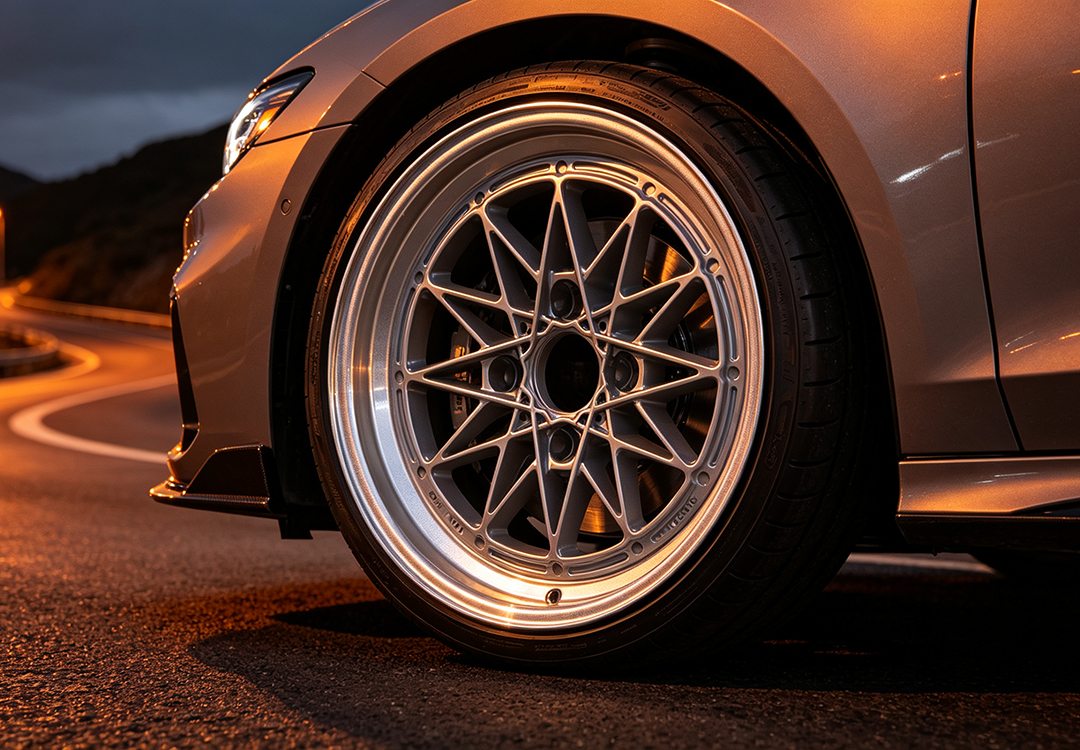
3. How to Find the Correct Wheel Size for Your Car
Installing incorrectly sized wheels introduces severe safety risks, including speedometer inaccuracy, tire rubbing against suspension struts or fender liners, and increased strain on wheel bearings.
Decoding Wheel Measurements
Wheel size is universally expressed in a standardized format stamped on the back of the wheel hub or inner spoke flange (for example: 18 x 8.5J ET40).
-
18 (Wheel Diameter): The distance in inches measured across the wheel face from bead seat to bead seat.
-
8.5 (Wheel Width): The interior distance in inches between the inner and outer rim flanges where the tire sits.
-
J (Bead Profile): A standardized shape code defining the contour of the rim flange (J is the standard for most passenger vehicles).
-
ET40 (Offset): The offset distance in millimeters (40mm in this example).
   <------------------ Wheel Diameter (e.g., 18") ------------------>
   +----------------------------------------------------------------+
   |                                                                |
   |   [Rim Bead Seat]                               [Rim Bead Seat]|
   +------\                                                    /----+
           \                                                  /
            \                                                /
             |---          Width (e.g., 8.5")            ---|
3 Steps to Verify Your Vehicle’s Factory Wheel Specs
-
Inspect the B-Pillar Sticker: Open your driver’s side door and read the tire and loading information placard attached to the door jamb. It lists factory wheel diameter, original equipment (OE) tire dimensions, and cold tire inflation pressures.
-
Read the Tire Sidewall Markings: Look at the alphanumeric code raised on your rubber tire (e.g., 225/45 R18). The final digits following the letter “R” designate your required wheel diameter in inches (18 inches).
-
Consult Your Owner’s Manual: Vehicle documentation details approved alternate wheel width and offset tolerances directly from the manufacturer.
4. Understanding Wheel Offset (ET) and Backspacing
Installing a wheel with the correct diameter and width is only half the battle. You must also account for Wheel Offset and Backspacing to prevent clearance issues with suspension components and brake calipers.
What Is Wheel Offset (ET)?
Wheel offset—derived from the German word “Einpresstiefe” (ET)—measures the millimeter distance between the wheel’s true centerline and the flat surface that bolts against the vehicle’s axle hub.
There are three categories of wheel offset:
-
Positive Offset (+ET): The mounting hub face sits closer to the front (street side) of the wheel face. Common on front-wheel drive and modern all-wheel drive vehicles. Pulls the wheel inward toward the bodywork.
-
Zero Offset (ET0): The mounting hub face aligns perfectly with the geometric centerline of the wheel width.
-
Negative Offset (-ET): The mounting hub face sits closer to the back (brake side) of the wheel. This creates a deep-lip or “deep dish” appearance, pushing the wheel outward away from the chassis. Common on rear-wheel drive muscle cars, classic hot rods, and lifted off-road trucks.
       OUTSIDE (Street Side)                     INSIDE (Brake Side)

       +-------------------------|-------------------------+
       |                         |                         |
       |       Positive Offset   |   Negative Offset       |
       |          (+ET)          |        (-ET)            |
       |                         |                         |
       |                    Centerline                     |
       +-------------------------|-------------------------+
                                 ^
                          [Zero Offset ET0]
Why Offset Matters for Driving Safety
Deviating too far from your car’s factory offset specification introduces immediate handling and wear issues:
-
Excessive Positive Offset: The inner lip or tire sidewall scrapes against inner fender liners, strut towers, or sway bar links.
-
Excessive Negative Offset: The tire pushes outward, potentially hitting the outer sheet metal fender lip during suspension compression.
-
Scrub Radius Disruption: Altering offset changes the vehicle’s scrub radius, which can cause steering wheel kickback under heavy braking, aggressive tramlining (where the car follows road grooves), and accelerated wheel bearing failure.
5. Critical Technical Specifications: Bolt Patterns and Hub Centricity
Even if diameter, width, and offset are correct, a wheel will not mount safely unless its mechanical fastening parameters match your axle hub assembly.
Pitch Circle Diameter (PCD) / Bolt Pattern
The bolt pattern designates the number of lug holes on the wheel and the diameter of the imaginary circle they form. Expressed as Lug Count x Circle Diameter in Millimeters (or inches in classic American applications).
-
Example: 5×114.3 means 5 lug holes positioned evenly around a 114.3mm diameter pitch circle.
-
Common Standards: 4×100 (subcompacts), 5×112 (European vehicles like Audi/VW/BMW), 5×114.3 / 5×4.5″ (Japanese and American sedans/SUVs), 6×139.7 (light trucks/full-size SUVs).
Crucial Rule: You cannot safely force a wheel with a 5×120 bolt pattern onto a vehicle with a 5×114.3 hub without using certified hub adapters or redrilling.
Hub-Centric vs. Lug-Centric Fitment
When a wheel is installed, the weight of the car should ideally be supported by the center bore resting tightly on the raised hub snout of the axle, not solely by the threaded wheel studs.
-
Hub-Centric Wheels: The center bore hole on the back of the wheel matches the exact millimeter diameter of the car’s axle hub. The vehicle’s weight rests securely on the solid metal hub snout.
-
Lug-Centric Wheels: The wheel’s center bore is intentionally oversized to accommodate multiple car models. The wheel relies entirely on the tapered seats of the lug nuts to center itself.
The Role of Hub-Centric Rings
If you install an aftermarket wheel with a center bore larger than your vehicle’s axle hub (e.g., a 73.1mm wheel bore on a 66.1mm vehicle hub), you will experience high-speed steering wheel vibrations. Installing high-strength polycarbonate or aluminum Hub-Centric Rings bridges this gap, transforming a lug-centric aftermarket setup into a smooth, vibration-free hub-centric fitment.
       +-------------------------------------------------+
       |           Aftermarket Wheel Center Bore         |
       |                     (73.1 mm)                   |
       |  +-------------------------------------------+  |
       |  |          HUB-CENTRIC RING SPACE           |  |
       |  |  +------------------------------------- + |  |
       |  |  |    Vehicle Axle Hub (66.1 mm)        | |  |
       |  |  +------------------------------------- + |  |
       |  +-------------------------------------------+  |
       +-------------------------------------------------+
6. How Upgrading Your Wheels Affects Performance
Replacing your factory set opens up two main installation approaches: staying with stock dimensions or upsizing (commonly known as “Plus-Sizing”).
The Mechanics of Plus-Sizing (e.g., Plus One, Plus Two)
Plus-sizing involves increasing the metal wheel diameter by 1 or 2 inches while simultaneously installing a lower-profile rubber tire. This keeps the overall rolling circumference of the tire equivalent to the stock assembly, ensuring your speedometer remains accurate.
   Stock (17" Wheel + Tall Tire)         Plus-Two (19" Wheel + Low-Profile Tire)

       /---------------\                     /---------------\
      /   ===========   \                   /   ===========   \
     /   /           \   \                 /   /           \   \
    |   |    17"      |   |               |   |    19"      |   |
    |   |   Wheel     |   |               |   |   Wheel     |   |
     \   \           /   /                 \   \           /   /
      \   ===========   /                   \   ===========   /
       \---------------/                     \---------------/
   [Overall Diameter Stays Same]         [Overall Diameter Stays Same]
Performance Advantages of Larger Wheels & Lower Profile Tires
-
Sharper Steering Response: Shorter tire sidewalls flex significantly less during aggressive cornering maneuvers.
-
Enlarged Brake Clearance: Larger wheel diameters allow room to fit oversized multi-piston big brake kits.
-
Enhanced Road Feel: Transmit clearer feedback from the road surface directly to the driver’s hands.
Trade-Offs to Consider
-
Firm/Harsher Ride Quality: Less rubber sidewall insulation means road impacts and potholes transfer directly into the cabin.
-
Increased Risk of Damage: Low-profile tires offer less cushion, making wheels more susceptible to bending when impacting severe potholes or curb edges.
-
Weight Penalty (Cast Wheels): Larger cast wheels add unsprung mass, slightly reducing acceleration punch and increasing fuel consumption.
7. Safety Inspection, Maintenance, and Troubleshooting
Your wheels operate in an extreme environment exposed to intense brake heat, road salt, chemical de-icers, and high-impact kinetic force. Regular maintenance ensures both safe driving and long-term finish retention.
Identifying Wheel Damage
Never ignore persistent cabin vibrations or unexplained tire pressure loss. Perform visual checks periodically for the following conditions:
-
Bent Flanges: Typically occurs on the inner barrel rim lip after hitting a deep pothole. Causes high-speed harmonics and slow air leaks along the tire bead.
-
Hairline Structural Cracks: Frequently forms near the base of the spokes or along the inner barrel edge. Driving on a cracked wheel is extremely hazardous and can lead to sudden wheel failure under load.
-
Clearcoat Corrosion: Severe brake dust buildup combined with winter road salts eats through the protective clear coat, causing pitting, finish bubbling, and aluminum oxidation.
Safe Cleaning Practices for Alloy Finishes
-
Never Clean Hot Wheels: Allow brakes and wheel surfaces to cool completely before spraying water or cleaning solutions. Thermal shock can warp brake rotors or crack delicate clear coats.
-
Use pH-Neutral Cleaners: Avoid harsh acid-based cleaners. Stick to dedicated, non-acidic wheel soaps that dissolve iron particle brake dust safely.
- Apply Protective Sealants: Protect polished or painted finishes by applying a high-temp synthetic wax or ceramic coating twice per year. This repels brake dust adhesion and simplifies future wash cycles.
Frequently Asked Questions (FAQ)
Here are clear, concise answers to the most common questions drivers ask when purchasing a replacement wheel for a car.
Q1: What are the main differences between alloy wheels and steel wheels?
Answer: Alloy wheels (usually aluminum) are lightweight, offer better heat dissipation, and improve vehicle handling and fuel efficiency, but are more expensive and prone to cosmetic damage. Steel wheels are heavier, highly durable, and cost-effective, making them ideal for rough conditions and winter driving.
Q2: What does wheel offset (ET) mean and why is it important?
Answer: Wheel offset (ET) refers to the distance from the wheel’s mounting hub surface to its true centerline. It determines how far the wheel sits inside or outside the wheel well. Incorrect offset can cause the wheel or tire to rub against suspension components, brake calipers, or fenders.
Q3: Is it safe to drive with a bent or cracked car wheel?
Answer: No. Driving on a damaged wheel can cause slow air leaks, vibration at high speeds, uneven tire wear, and in severe cases, catastrophic tire blowout or wheel failure. A bent or cracked wheel should be inspected and repaired or replaced immediately.
Q4: Can I install wider wheels on my car without modifying the bodywork?
Answer: Yes, provided the new width and offset remain within your chassis’s clearance envelope. If you widen the wheel too much toward the fender side, you may need to roll your fender lips; if extended too far inward, the wheel may hit suspension components or require hub spacers.
Q5: What are lug nut seat profiles, and why do they matter?
Answer: The contact surface where the lug nut meets the wheel hole comes in three distinct shapes: Conical (60-degree taper), Ball/Radius (curved seat, common on OE European cars), and Flat Mag Seat (with a washer). Using the incorrect lug nut profile prevents proper clamping force and can cause lug nuts to back out while driving.
Final Thoughts: Upgrade Your Drive with Confidence
Choosing the ideal wheel for your car comes down to balancing structural engineering with personal aesthetic tastes. By cross-referencing your vehicle’s factory hub diameter, bolt pattern (PCD), and offset range before making a purchase, you ensure a clean fit that improves road dynamics without compromising safety.
Ready to transform your vehicle’s stance and handling performance? Explore high-quality aftermarket wheels at ATK Wheels to browse precision-engineered fitments built for long-term durability, style, and road performance.

