
Car Alloy Wheels: Benefits, Types, Performance, Fitment and Maintenance
Car Alloy Wheels: Benefits, Types, Performance, Fitment and Maintenance
Upgrading your vehicle with high-quality car alloy wheels is one of the most effective mechanical and visual modifications you can perform. While factory steel rims provide basic, heavy-duty transportation, swapping them for precision-engineered aluminum or magnesium alloy wheels fundamentally transforms how your vehicle accelerates, corners, dissipates braking heat, and consumes fuel.
Whether you operate a daily commuter sedan, a heavy-duty pickup truck, an off-road crossover, or a high-horsepower sports car, understanding how alloy wheels interact with your suspension geometry, unsprung weight, and tire package equips you to make smarter aftermarket purchasing decisions.
1.What Are Car Alloy Wheels and How Are They Engineered?
At their core, car alloy wheels are engineered metallic rims crafted from a precise blend of non-ferrous lightweight metals—primarily aluminum or magnesium—combined with trace strengthening elements like silicon, nickel, copper, or manganese. Unlike traditional carbon steel wheels, which are stamped from heavy sheet metal and robotically welded together, alloy wheels are manufactured using advanced metallurgical processes designed to balance structural durability with minimal mass.
By combining pure elements into specialized metallic alloys, automotive engineers achieve a significantly higher strength-to-weight ratio than raw steel provides. This allows manufacturers to engineer intricate spoke architectures, wide rim widths, and specialized barrel profiles without adding excess rotational weight.
Raw Aluminum Alloy Billet ➔ Thermal Processing ➔ Casting / Flow-Forming / Forging ➔ Precision CNC Machining ➔ Protective Surface Finish
Primary Material Formulations
-
Aluminum Alloy Wheels: The universal industry standard for consumer and commercial vehicles. Aluminum offers an optimal balance of low physical density, natural atmospheric corrosion resistance, high thermal conductivity, and structural ductility.
-
Magnesium Alloy Wheels (Mag Wheels): Reserved primarily for high-level motorsports, track cars, and exotic supercars. Magnesium is roughly 30% lighter than aluminum, though it requires specialized protective surface coatings to prevent rapid environmental oxidation.
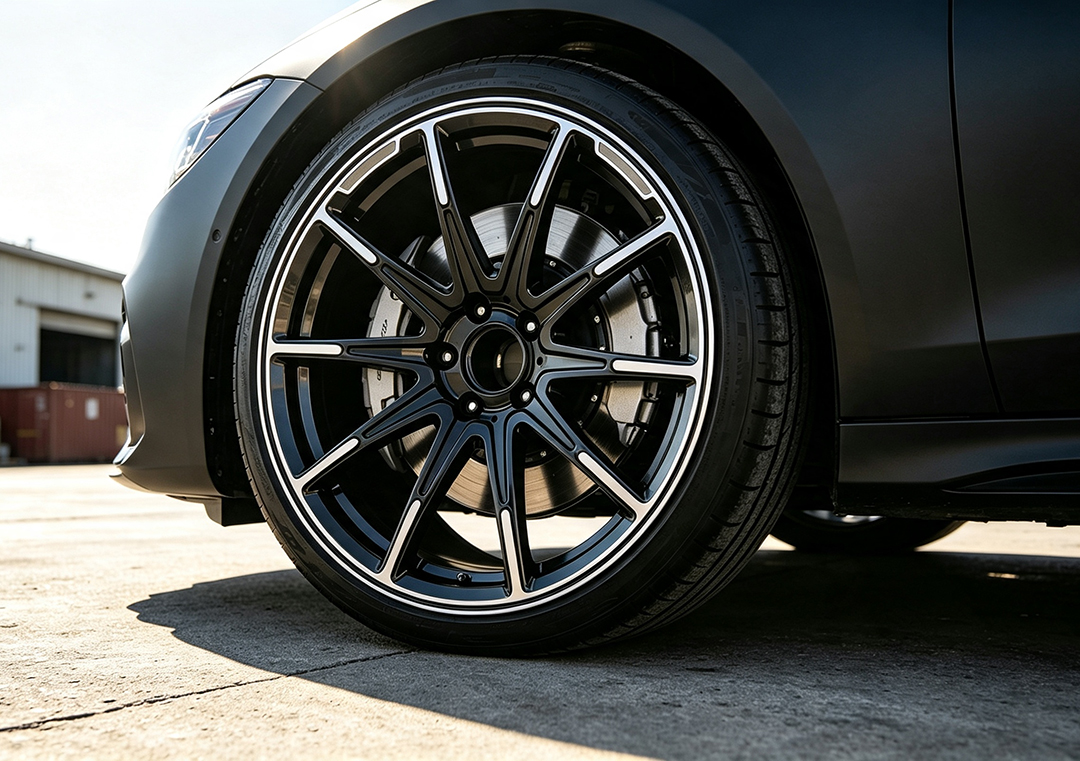
2.Alloy Wheels vs. Steel Wheels: Core Differences
When evaluating factory options or planning an aftermarket wheel upgrade, reviewing the primary technical differences between traditional steel rims and modern alloy wheels clarifies why alloys dominate the modern vehicle market.
| Key Metric | Car Alloy Wheels | Steel Wheels |
|---|---|---|
| Material Composition | Aluminum or Magnesium Alloy | Stamped Carbon Steel |
| Manufacturing Method | Casting, Flow-Forming, or Forging | Stamping and Welding |
| Average Component Weight | 15% to 30% lighter than steel | Heavy, high-density mass |
| Unsprung Mass Impact | Low (enhances suspension reaction) | High (increases shock wear) |
| Handling & Steering Response | Crisp, precise, minimal spoke flex | Sluggish, increased body roll |
| Fuel Efficiency Impact | Improved (lower rotational inertia) | Standard / Baseline |
| Heat Dissipation | Superior (rapid brake thermal cooling) | Poor (traps friction heat) |
| Design & Finish Variety | High (chrome, gloss black, machined face) | Basic (requires plastic hubcaps) |
| Impact Resistance | Rigid; deforms or cracks under severe hit | Bends under impact; easy to reshape |
| Corrosion Resistance | Highly resistant to rust | Prone to surface rust if paint chips |
| Price Point | Moderate to Premium Investment | Low / Budget-Friendly |
3.How Car Alloy Wheels Elevate Vehicle Dynamics and Fuel Economy
Upgrading to lightweight car alloy wheels is far more than an aesthetic enhancement—it alters dynamic vehicle physics by addressing two fundamental engineering principles: unsprung mass and rotational inertia.
Reduced Unsprung Mass ➔ Rapid Suspension Response ➔ Constant Tire Contact Patch ➔ Maximum Mechanical Grip
1. Reduction of Unsprung Mass
Unsprung mass encompasses every component situated below the suspension springs—including wheels, tires, wheel bearings, hubs, and brake rotors. Because your vehicle’s suspension system must constantly push the wheels down onto uneven road surfaces, reducing unsprung weight yields immediate dynamic advantages:
-
Shock absorbers and coil springs react significantly faster to potholes, dips, and road imperfections.
-
Tires maintain a more continuous contact patch with the pavement, maximizing traction.
-
Steering wheel feedback becomes crisp, immediate, and highly communicative.
2. Lower Rotational Inertia & Better Fuel Economy
It requires far less engine power to spin up—and less braking torque to slow down—a lighter rotating assembly. Lowering rotational inertia decreases engine workload during city acceleration, directly contributing to better city miles per gallon (MPG). Furthermore, lighter rotational mass reduces thermal stress on brake pads and calipers, shortening stopping distances and extending brake component lifespans.
3. Superior Thermal Dissipation for Brakes
Aluminum alloys exhibit high thermal conductivity. The open spoke geometry of modern alloy wheels pulls intense friction heat away from brake calipers and rotors, dissipating it into passing airflow. This rapid thermal transfer minimizes the occurrence of brake fade during mountain driving, heavy towing, or spirited driving.
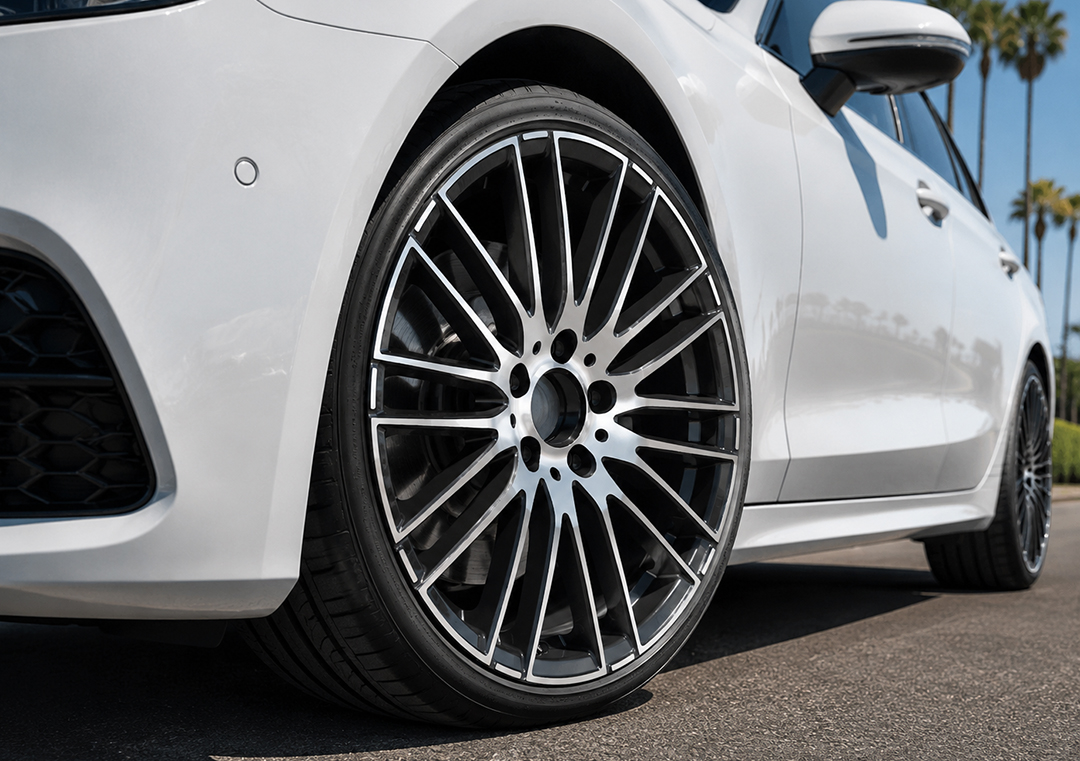
4.Manufacturing Technologies: Cast vs. Flow-Formed vs. Forged Alloy Wheels
Not all car alloy wheels are built using the same manufacturing processes. The specific production technique dictates the metal’s internal grain density, structural impact strength, overall weight, and market cost.
Manufacturing Hierarchy (Strength & Grain Density)
[Gravity / Low-Pressure Casting] ➔ [Flow Forming / Spin Forging] ➔ [Full Precision Forging]
1. Low-Pressure and Gravity Casting
Casting remains the most common manufacturing method for stock replacement rims and budget aftermarket wheels.
-
The Process: Liquid aluminum alloy is poured (gravity casting) or drawn under low air pressure (low-pressure casting) into a pre-shaped wheel mold.
-
Characteristics: Highly cost-effective to manufacture, supporting intricate aesthetic designs. However, cast aluminum contains minor microscopic porosity, requiring thicker structural walls that add overall weight.
2. Flow Forming (Spin Forging)
Flow forming bridges the gap between affordable cast wheels and ultra-high-end forged options.
-
The Process: A specialized cast wheel blank is mounted onto a heated spinning mandrel. High-pressure hydraulic rollers compress and stretch the outer rim barrel longitudinally.
-
Characteristics: Realigns the alloy’s crystalline grain structure along the barrel, increasing tensile strength by 20% to 30% while significantly reducing barrel weight.
3. Precision Forged Alloy Wheels
Forged wheels represent the absolute peak of wheel engineering.
-
The Process: Solid billets of aerospace-grade aluminum (such as 6061-T6) are subjected to massive hydraulic presses exerting over 10,000 tons of pressure. The metal is never melted; instead, extreme heat and pressure align the aluminum grain flow with the contours of the wheel spokes before precision multi-axis CNC machining finishes the profile.
-
Characteristics: Maximum structural strength, extreme resistance to impact deformation, and minimum mass. Forged wheels are the primary choice for track vehicles, high-torque trucks, and performance supercars.
5.Essential Fitment Specifications Explained
Selecting the correct aftermarket alloy wheels requires evaluating precise dimensional specs to ensure clearance around suspension arms, brake calipers, and fender arches.
Sample Specification Tag: 18 x 8.5J | 5x114.3 | ET+35 | CB 67.1mm
-
Wheel Diameter and Width (e.g., 18 x 8.5J): Measured in inches across the outer face bead seat and the inner barrel width between the rim flanges.
-
Pitch Circle Diameter (PCD / Bolt Pattern, e.g., 5×114.3): The first digit indicates the total lug hole count; the second represents the diameter of the imaginary circle running through the lug centers in millimeters.
-
Wheel Offset (ET, e.g., ET+35): The distance in millimeters from the wheel’s physical centerline to its mounting hub pad:
-
Positive Offset (+ET): Pulls the wheel inward toward the chassis (standard on modern FWD and AWD passenger cars).
-
Zero Offset (0 ET): Aligns the mounting surface directly with the geometric centerline.
-
Negative Offset (-ET): Pushes the rim face outward away from the body, creating a wide stance and deep-lip profile popular on lifted trucks and off-road builds.
-
-
Center Bore (CB, e.g., 67.1mm): The machined opening on the rear of the wheel that seats onto the vehicle’s axle hub snout. Using hub-centric rings ensures a precise fit that eliminates high-speed steering vibration.
6.Routine Cleaning and Maintenance Guidelines
Car alloy wheels face constant exposure to corrosive brake dust, road salt, chemical deicers, and hot asphalt tar. Establishing a consistent care routine protects their clear coat finish and structural integrity over time.
Cool Wheel Surface ➔ Apply pH-Neutral Cleaner ➔ Agitate with Soft Brush ➔ Thorough Water Rinse ➔ Seal with Synthetic Wax
Maintenance Best Practices
-
Always Wash Cool: Never spray water or chemical cleaners onto hot alloy wheels immediately after driving. Rapid temperature changes can thermal-shock hot aluminum, causing clear coats to crack or warping structural brake rotors.
-
Use pH-Neutral Solutions: Avoid aggressive acid-based cleansers. Stick to dedicated pH-neutral wheel cleaners or standard automotive shampoo that breaks down metallic brake dust without compromising protective lacquer coats.
-
Use Dedicated Cleaning Tools: Reserve soft microfiber mitts and non-scratch soft-bristle barrel brushes exclusively for wheel cleaning to prevent transferring metallic brake particles onto delicate vehicle paintwork.
-
Apply Protective Coatings: Applying a high-temperature synthetic wheel sealant or ceramic coating twice a year creates a slick hydrophobic layer that repels corrosive brake dust buildup and road grime.

Frequently Asked Questions(FAQ)
1.What is the difference between alloy wheels and steel wheels?
Alloy wheels are made from aluminum or magnesium, offering lighter weight, better fuel efficiency, and superior handling. Steel wheels are heavier, cheaper, and more durable against harsh impacts, but lack aesthetic options.
2.Do alloy wheels improve car performance and fuel economy?
Yes. Their lighter weight reduces unsprung mass, which improves acceleration, handling, and braking response. Lower weight also decreases rolling resistance, contributing to better fuel efficiency.
3.What is the difference between cast and forged alloy wheels?
Cast wheels are made by pouring molten metal into molds, making them cost-effective but heavier. Forged wheels are compressed from solid metal under extreme pressure, rendering them lighter, stronger, and more expensive.
4.How do I maintain and clean alloy wheels properly?
Clean them regularly with pH-neutral soap, water, and a soft microfiber brush to remove damaging brake dust. Avoid harsh acid-based cleaners and cold-water rinses when the wheels are hot to prevent finish cracking.
5.Can damaged alloy wheels be repaired?
Minor cosmetic issues like curb rash, scratches, or shallow bends can be safely repaired. However, severely cracked, structurally warped, or welded-over wheels should be replaced due to compromised safety.
Elevate Your Driving Dynamics Today
Choosing high-grade car alloy wheels delivers the ultimate combination of striking visual appeal, refined steering precision, and functional efficiency. Whether you are replacing worn factory rims or building a custom performance setup, matching your driving needs with the right alloy construction and fitment specifications guarantees a safer, smoother, and more responsive ride.
Ready to explore wheel upgrades engineered for your exact make and model? Browse the comprehensive collection of cast, flow-formed, and custom forged wheel setups at ATK Wheels to find your vehicle’s precise fitment.

