Are Wheel Spacers Safe? Everything You Need to Know About Fitment and Costs
Are Wheel Spacers Safe? Everything You Need to Know About Fitment and Costs
Whether you want to clear a bigger set of aftermarket brakes, fix an annoying fitment issue, or give your car a flush, aggressive stance, wheel spacers are one of the most popular bolt-on modifications available. However, despite their simplicity, wheel spacers are surrounded by debate, myths, and safety concerns.
Are wheel spacers safe for daily driving? Do they ruin your suspension alignment? How much should you expect to pay for a reliable set?
In this comprehensive guide, we will break down everything you need to know about wheel spacers—from how they work and their impact on vehicle dynamics to safety considerations, legal requirements, and installation practices.
What Does a Wheel Spacer Do?
A wheel spacer is a metal disc—typically forged from high-grade aluminum or steel—that fits directly between your vehicle’s wheel hub and the wheel itself.
[Vehicle Hub] ---> [Wheel Spacer] ---> [Wheel]
By adding physical thickness between the hub and the wheel face, a spacer pushes the entire wheel assembly outward away from the vehicle’s centerline. This effectively widens the vehicle’s total track width.
1. Clearing Aftermarket Brake Kits & Suspension Parts
When upgrading to big brake kits (BBKs) or aftermarket coilover suspension systems, the back face or spokes of the wheel may rub against the caliper or spring perch. A thin wheel spacer creates the necessary millimeter clearance to prevent contact.
2. Correcting Wheel Offset Issues
If you buy custom wheels with a high positive offset ($ET$), they may sit too deep inside the wheel well, looking sunken or scraping inner fender liners. Spacers reduce effective offset, bringing the wheel back into a proper position.
3. Achieving an Aggressive “Flush” Stance
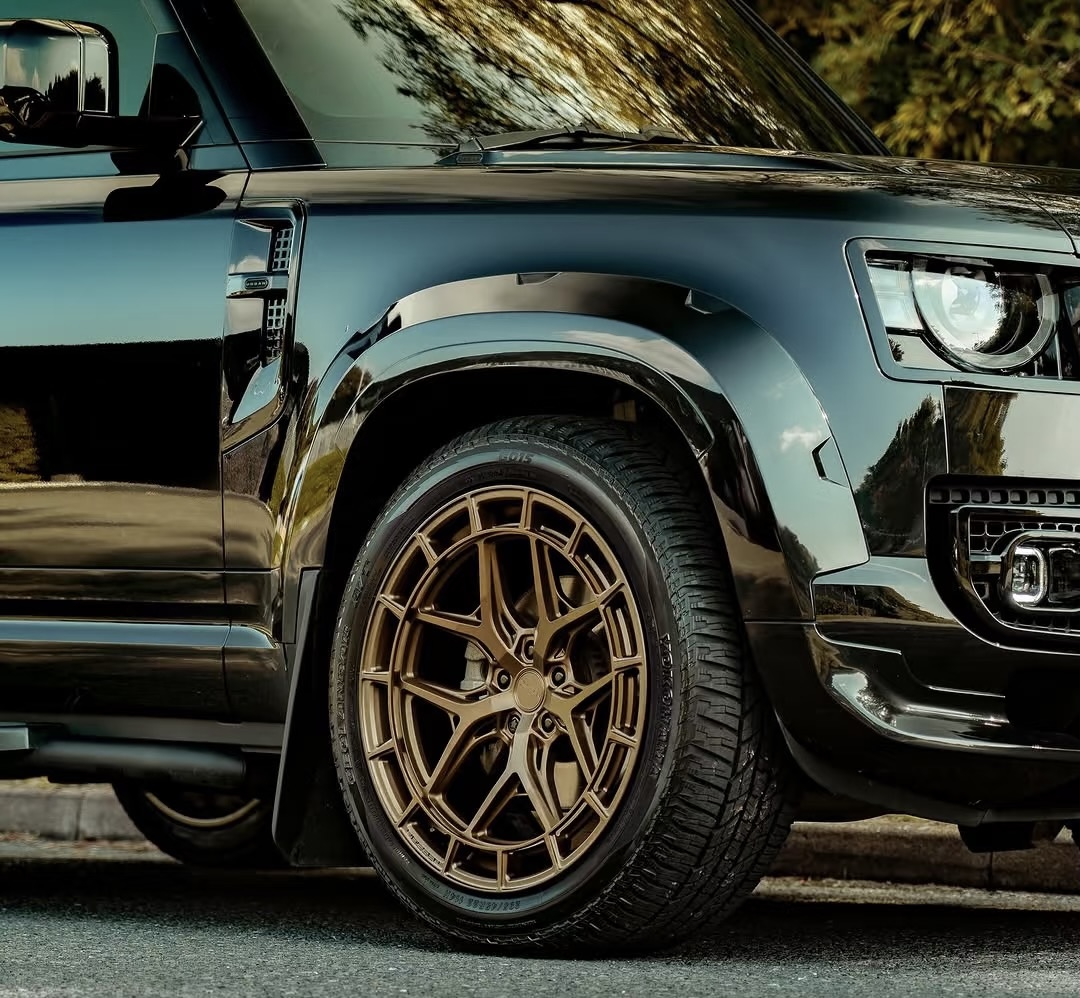
Car enthusiasts frequently use spacers for aesthetic reasons. By moving the outer edge of the tire in line with the fender lip, you eliminate unsightly wheel tuck without buying entirely new wheels.
Wheel Spacers vs. Wheel Adapters: What’s the Difference?
While many drivers use the terms interchangeably, spacers and adapters serve distinct purposes:
| Feature | Wheel Spacer | Wheel Adapter |
|---|---|---|
| Primary Function | Pushes wheel outward; keeps original bolt pattern | Pushes wheel outward AND changes bolt pattern |
| Bolt Pattern | Same pattern on both sides (e.g., $5\times114.3$ to $5\times114.3$) | Converts patterns (e.g., $5\times100$ to $5\times114.3$) |
| Typical Thickness | Thin to moderate ($3\text{mm}$ to $25\text{mm}+$) | Generally thicker ($15\text{mm}$ to $50\text{mm}+$) |
| Best Used For | Stance, brake clearance, offset adjustment | Mounting wheels designed for a different make/model |
Hub-Centric vs. Lug-Centric Spacers: Why It Matters
When buying wheel spacers, the single most critical decision is choosing between hub-centric and lug-centric designs.
HUB-CENTRIC DESIGN (Recommended)
[ Wheel Hub Lip ] ===> [ Spacer Hub Ring ] ===> [ Wheel Center Bore ]
* Weight supported by the hub lip. Zero vibration.

LUG-CENTRIC DESIGN (Use with Caution)
[ Flat Hub ] =====> [ Flat Spacer ] =====> [ Wheel Center Bore ]
* Weight supported entirely by lug studs/bolts. High vibration risk.
Hub-Centric Spacers (Highly Recommended)
Hub-centric spacers feature a machined center ring that precisely matches your vehicle’s factory hub diameter and your wheel’s center bore.
-
How it works: The vehicle’s weight rests directly on the solid center hub lip, exactly as the factory designed.
-
Result: Smooth ride, zero wheel wobble, and maximum load transfer safety.
Lug-Centric Spacers
Lug-centric spacers are flat discs with oversized center holes designed to fit multiple vehicle bolt patterns.
-
How it works: Because the center bore is universal, the spacer relies entirely on the lug studs or bolts to center the wheel and bear vehicle load.
-
Result: If lug nuts are torqued even slightly unevenly, the wheel sits off-center, causing high-speed steering wheel vibrations and shearing stress on the wheel studs.
Expert Recommendation: Always opt for high-quality, forged hub-centric wheel spacers engineered specifically for your vehicle’s make, model, and hub diameter.
Are Wheel Spacers Safe?
Yes, wheel spacers are safe when high-quality, hub-centric components are installed correctly and torqued to manufacturer specifications. The widespread myth that spacers are dangerous usually stems from improper installation, cheap materials, or using non-hub-centric spacers.
Key Safety Checklist:
✓ Forged T6-6061 or T6-7075 aluminum material
✓ Vehicle-specific hub-centric fitment
✓ Minimum 6 to 8 full turns of thread engagement
✓ Hand-torqued with a calibrated torque wrench
Risks of Cheap or Poorly Installed Spacers:
-
Inadequate Thread Engagement: Pushing the wheel outward without extending thread length reduces bolt engagement, increasing the risk of studs shearing off.
-
Wheel Vibration: Lug-centric designs can cause imbalances felt in the steering wheel at highway speeds ($55\text{–}70\text{ mph}$).
-
Accelerated Wear: Extremely thick spacers ($30\text{mm}+$) alter overall leverage, which can put extra strain on wheel bearings and ball joints over extended periods.
Do Wheel Spacers Throw Off Your Alignment?
Wheel spacers do not directly alter your fundamental alignment settings—they do not change your camber, caster, or toe angles.
However, spacers do change your vehicle’s scrub radius (the distance between the steering axis intersection point and the center of the tire contact patch).
How Scrub Radius Affects Driving Dynamics:
-
Increased Leverage: Pushing the wheel outward creates a longer lever arm against your control arms and springs, slightly softening effective spring rates.
-
Steering Feedback: A larger scrub radius increases steering effort slightly and can amplify pre-existing front-end alignment issues, worn bushings, or unbalanced tires.
If your vehicle drove straight and smoothly before installing spacers, it will continue to do so afterward. However, getting a professional alignment check after modifying track width is always a smart maintenance practice.
How Much Do Wheel Spacers Cost?
The cost of wheel spacers varies depending on materials, thickness, whether extended hardware is included, and brand reputation.
| Option | Estimated Price Range | What's Included / Notes |
|---|---|---|
| Entry-Level (Slip-On) | $\$20\text{ – }\$50$ per pair | Thin ($3\text{mm}\text{–}5\text{mm}$), non-hub-centric, hardware not included |
| Quality Hub-Centric (Slip-On) | $\$60\text{ – }\$120$ per pair | Precision-machined aluminum; extended studs/bolts required |
| Bolt-On Hub-Centric Spacers | $\$80\text{ – }\$200$ per pair | Includes pre-installed Grade 10.9 studs and low-profile nuts |
| Full Set (4 Wheels) | $\$150\text{ – }\$400+$ full set | High-grade forged T6 aluminum set for all four corners |
| Professional Installation | $\$75\text{ – }\$150$ shop fee | Labor cost if performed by a licensed tire/mechanic shop |
Are Wheel Spacers Legal in the United States?
Wheel spacers are legal across the United States at the federal level. There are no U.S. Department of Transportation (DOT) bans on using wheel spacers for passenger cars and light trucks.
However, state-level regulations govern tire coverage and overall vehicle width:
-
Fender Coverage Laws: States like California, Pennsylvania, and Hawaii require the tire tread to remain covered by the bodywork or fender flares. If your spacers cause tires to poke beyond the bodyline, you may fail state inspection or receive a citation.
-
Track Width Limits: Certain states restrict total track width modifications to prevent excessive leverage on suspension components.
Always check your local state transportation code regarding fender poke and wheel track width before choosing spacer thickness.
Step-by-Step Installation Guide
Installing wheel spacers properly is vital for safety. Follow these steps for a secure fitment:
Step 1: Clean Hub Surface  ──>  Step 2: Test Fit Spacer  ──>  Step 3: Apply Threadlocker
                                                                    │
Step 5: Final Torque Check  <──  Step 4: Star-Pattern Torque  <─────┘
-
Prepare and Clean the Hub: Use a wire brush and brake cleaner to remove rust, road grime, and debris from the factory wheel hub face. The spacer must sit completely flat.
-
Test Fit: Slide the spacer onto the hub without the wheel. Ensure it fits flush against the rotor hat with no gaps.
-
Verify Thread Engagement: * For slip-on spacers, ensure your factory studs allow at least 6 to 8 full turns of the lug nut. If not, install extended lug studs.
-
For bolt-on spacers, secure the spacer to the hub using the provided short lug nuts.
-
-
Torque to Specs: Mount the wheel onto the spacer. Use a calibrated torque wrench to tighten lug nuts in a star pattern to factory torque specifications (typically $80\text{–}100\text{ ft-lbs}$ for cars, $100\text{–}140\text{ ft-lbs}$ for trucks). Never use an impact wrench for final tightening.
-
Re-Torque After 50–100 Miles: Stop and re-torque all lug nuts after driving $50\text{ to }100\text{ miles}$ to allow components to seat properly.
Frequently Asked Questions (FAQ)
What does a wheel spacer do?
A wheel spacer creates distance between the wheel hub and the wheel itself. It pushes the wheel outward to widen track width, clear aftermarket brakes/suspension parts, or eliminate wheel tuck for a flush look.
Is it safe to put spacers on wheels?
Yes, high-quality, hub-centric wheel spacers are safe for daily driving when correctly torqued to vehicle specifications. Avoid cheap universal spacers and verify proper lug thread engagement.
Do wheel spacers affect ride quality?
When properly installed, hub-centric spacers do not cause vibrations or degrade ride quality. However, because they widen track width, you may notice slightly increased road feedback through the steering wheel.
Do I need an alignment after installing wheel spacers?
Spacers do not alter factory camber, caster, or toe settings. However, because they change the vehicle’s scrub radius, getting an alignment check helps ensure optimal tire wear and handling.
How thick of a wheel spacer can I run safely?
Most standard street vehicles run spacers between $5\text{mm}$ and $25\text{mm}$. For spacers under $10\text{mm}$, extended wheel studs or extended bolt shanks are usually required. Spacers over $15\text{mm}$ typically use a bolt-on design with built-in studs.
Transform Your Vehicle’s Stance and Fitment Today
Finding the right balance between aggressive fitment, performance clearance, and daily safety comes down to using precision engineering.
If you’re ready to upgrade your vehicle’s stance or eliminate brake clearance issues, explore premium hub-centric options tailored to your specific vehicle specs at ATK Wheels. Browse custom wheel fitments, forged spacers, and expert guidance to complete your build with confidence.