
Hybrid Forged Wheels: What Drivers Should Know About Strength, Weight, and Value
Hybrid Forged Wheels: What Drivers Should Know About Strength, Weight, and Value
Upgrading your vehicle’s wheels is widely considered one of the most transformative modifications you can undertake. It alters your car’s visual stance instantly while directly dictating how the vehicle handles aggressive cornering, accelerates off the line, and decelerates under heavy braking. For decades, automotive enthusiasts faced a restrictive compromise: purchasing affordable yet heavy conventional cast wheels, or investing in ultra-strong, lightweight, but prohibitively expensive fully forged options.
Enter hybrid forged wheels—a modern manufacturing milestone engineered to bridge this performance and economic gap. By blending precise low-pressure casting with advanced rotary flow-forming barrel stretching, hybrid forged wheels give everyday drivers and track enthusiasts near-forged barrel strength and reduced weight at a fraction of the cost of fully forged alternatives.
Whether your goal is to reduce unsprung rotational weight for weekend track sessions, optimize suspension feedback on winding canyon roads, or simply enhance your daily driver’s aesthetic appeal, understanding the engineering behind hybrid forged wheels ensures you make an educated investment.
1.What Are Hybrid Forged Wheels?
A hybrid forged wheel (frequently designated as a flow-formed, flow-forged, rotary forged, or spun- forged wheel) is an advanced aftermarket aluminum alloy wheel manufactured through an innovative two-step production cycle:
-
Low-Pressure Casting Foundation: The initial wheel face, spoke architecture, and hub mounting pad are cast by injecting molten aluminum alloy into a customized steel mold under regulated pressure.
-
Rotary Flow-Forming Transformation: The cast wheel blank (or preform) is transferred to a specialized high-speed hydraulic spinning machine. While spinning at high revolutions under controlled high temperatures, heavy-duty hydraulic rollers apply intense radial pressure to compress, stretch, and elongate the aluminum along the inner barrel.
During this secondary rotary stretching phase, the internal molecular structure of the aluminum undergoes mechanical grain realignment. Much like traditional forging, the metal molecules are forced into a tight, uniform grain structure that dramatically boosts the tensile strength and impact resistance of the wheel barrel. This allows manufacturers to reduce barrel wall thicknesses significantly without compromising structural load capacity.
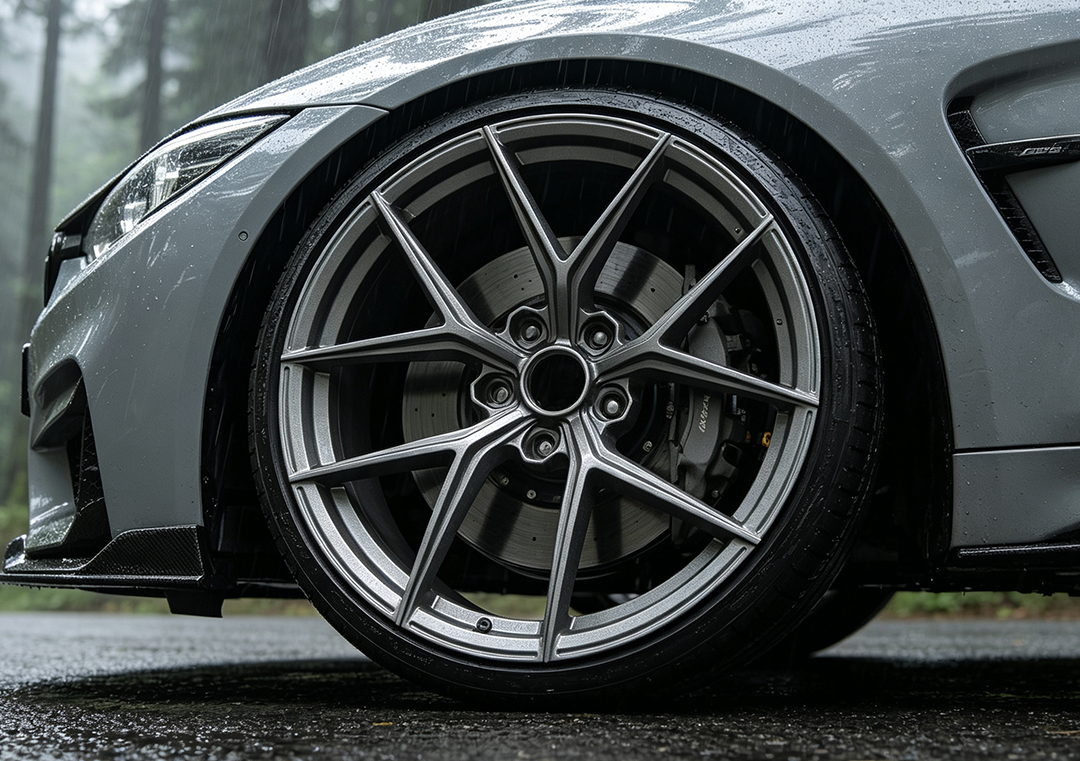
2.How Hybrid Forged Manufacturing Works in Detail
To appreciate the structural integrity of these components, it helps to examine the multi-stage engineering process required to turn raw alloy into a finished performance wheel.
Step 1: Precision Pre-Form Casting
Manufacturers utilize premium aluminum alloys (such as A356-T6 aerospace-grade aluminum) to cast the primary wheel blank. The face maintains the precise aesthetic profile, spoke geometry, and concave depth desired by designers. This casting phase allows for complex, intricate spoke designs that would be exceptionally expensive and time-consuming to machine completely from a solid block.
Step 2: Thermal Pre-Heating and Mandrel Mounting
The cast preform is preheated to exact thermal thresholds to optimize malleability. It is then securely mounted onto a heavy-duty cylindrical steel mandrel that corresponds to the target wheel diameter, width, and backspacing specifications.
Step 3: Hydraulic Flow-Forming Strain Hardening
As the mandrel spins at high RPMs, specialized hydraulic rollers press against the inner rim area. Under continuous pressure, the aluminum flows axially down the mandrel, stretching the material. This mechanical deformation strain-hardens the aluminum, aligning the grain boundaries into dense, parallel lines that resist bending and cracking.
Step 4: T6 Heat Treatment and CNC Finishing
Once the barrel is formed, the wheel undergoes comprehensive T6 heat treatment—involving solution heat-treating followed by artificial aging—to lock in maximum yield strength. Finally, multi-axis computer numerical control (CNC) machines precision-bore the center hub, drill precise bolt patterns (PCD), and tap valve stem holes to exact tolerances.
3.Key Benefits of Hybrid Forged Wheels
1. Significant Reduction in Unsprung Weight
Unsprung mass encompasses all vehicle components not supported by the suspension system, including wheels, tires, brake rotors, and wheel hubs. Minimizing rotational weight at the wheel barrel yields immediate performance gains:
-
Accelerated Throttle Response: Less engine power is wasted spinning up heavy wheel mass, allowing for quicker acceleration.
-
Shorter Stopping Distances: Lower rotational inertia enables brake systems to scrub off speed more efficiently.
-
Enhanced Suspension Dynamics: Lighter wheels reduce the workload on shocks and springs, enabling tires to maintain optimal contact patches over uneven road surfaces.
2. Exceptional Barrel Strength and Impact Resistance
Traditional casting often leaves microscopic porosities within the metal. The mechanical stretching and compression during flow-forming eliminate these imperfections, resulting in a denser, stronger barrel capable of withstanding severe road hazards like potholes and sharp impact forces.
3. High Design Versatility
Because the face is produced via precision casting, manufacturers can offer aggressive concave profiles, multi-spoke mesh patterns, and intricate window pockets that provide the custom look of expensive multi-piece or fully forged wheels.
4. Optimal Cost-to-Performance Ratio
Hybrid forged wheels deliver roughly 70% to 80% of the mechanical performance benefits of a fully forged wheel at approximately one-third of the financial investment.
4.Hybrid Forged vs. Cast vs. Fully Forged Wheels
Comparing wheel manufacturing technologies clarifies how different options align with specific driving styles and budgets.
| Feature | Standard Cast Wheels | Hybrid Forged Wheels | Fully Forged Wheels |
|---|---|---|---|
| Manufacturing Method | Gravity or Low-Pressure Molding | Cast Face + Flow-Formed Barrel | Solid Billet Machined under 10,000+ Ton Pressure |
| Aluminum Structure | Porous, random grain orientation | Densified, linear grain structure in barrel | Fully aligned grain structure throughout face & barrel |
| Barrel Strength | Baseline industry standard | High (Near-forged characteristics) | Maximum structural rigidity |
| Weight | Heaviest option | 15% – 25% lighter than cast | Lightest possible weight |
| Impact Resistance | Fair (Prone to cracking under heavy blows) | Excellent (Ductile and flex-resistant) | Superior strength-to-weight performance |
| Design Variety | Broad stylistic variety | Wide variety with deep concave options | Unlimited custom CNC milling potential |
| Price Tier | Economical entry-level | Best value for performance/Exclusive premium pricing | |
| Primary Application | Daily commuting, OEM replacements | Aggressive street driving, track days, performance builds | Professional motorsports, exotic supercars, high-end show cars |
5.Structural Performance and Industry Testing Standards
Ensuring safety under extreme cornering loads, high speeds, and severe road impacts requires rigorous testing protocols. Leading wheel manufacturers subject their flow-formed product lines to strict laboratory testing:
-
Radial Fatigue Testing: Simulates millions of wheel revolutions under maximum vehicle weight loads to ensure long-term structural resilience.
-
Cornering Fatigue Testing: Applies continuous bending moment forces to evaluate spoke and hub integrity.
-
Impact Testing: Drops heavy weights onto the rim flange to verify that the barrel deforms predictably and safely without shattering or sudden pressure loss.
Always verify that your wheels carry internationally recognized safety certifications such as VIA (Vehicle Inspection Association of Japan), JWL (Japan Light Alloy Wheel standard), or TÜV (Germany), which are typically stamped directly into the inner rim or back pad.
6.How to Select the Right Hybrid Forged Fitment
Choosing the correct set of wheels involves evaluating several precise technical specifications to ensure proper clearance and vehicle dynamics:
-
PCD and Bolt Pattern: Match your vehicle’s exact lug configuration (e.g., 5×112, 5×120, 5×114.3).
-
Center Bore and Hub Centricity: Ensure the wheel’s center bore matches your vehicle hub precisely, or utilize precision aluminum hub-centric rings to eliminate high-speed steering vibrations.
-
Offset (ET): Offset dictates how far inward or outward the wheel mounting surface sits relative to the centerline. Correct offset prevents rubbing against inner suspension components or outer fenders.
-
Load Rating: Confirm that the wheel’s maximum load rating exceeds your vehicle’s Gross Axle Weight Rating (GAWR)—an especially vital consideration for heavy electric vehicles (EVs) and high-performance SUVs.
Frequently Asked Questions(FAQ)
1.What are hybrid forged wheels?
Hybrid forged wheels utilize advanced flow-forming technology where a cast wheel preform is rotated under high heat and intense hydraulic pressure. This mechanical process stretches and compresses the metal within the wheel barrel, significantly enhancing its density, structural integrity, and tensile strength.
2.Are hybrid forged wheels stronger than cast wheels?
Yes. Hybrid forged wheels possess much stronger and denser wheel barrels than conventional cast wheels. The flow-forming manufacturing technique aligns the internal metal grain structure, boosting overall tensile strength and providing superior resistance against impacts from potholes and road debris.
3.Are hybrid forged wheels lighter than cast wheels?
Yes, hybrid forged wheels are typically 15% to 25% lighter than comparable cast wheels. Because the flow-forming process produces a significantly stronger aluminum barrel, engineers can reduce wall thickness without sacrificing load-bearing capacity.
4.What is the difference between hybrid forged and fully forged wheels?
Hybrid forged wheels combine a precision-cast center spoke face with a flow-formed barrel. In contrast, fully forged wheels are machined entirely from a single solid block of 6061-T6 aerospace aluminum subjected to thousands of tons of hydraulic forging pressure. Fully forged wheels offer the ultimate strength-to-weight ratio across both the face and barrel, but come with a substantially higher manufacturing cost.
5.Are hybrid forged wheels worth buying?
Absolutely. They represent the optimal choice for vehicle owners seeking an ideal balance of unsprung weight reduction, enhanced durability, striking aesthetic concavity, and reasonable pricing. Always verify load ratings, vehicle fitment compatibility, and safety certifications before finalizing your purchase.
Upgrade Your Ride with High-Performance Flow-Formed Wheels
Ready to redefine your vehicle’s visual stance and dynamic handling characteristics? Modern flow-formed and hybrid forged wheels deliver track-tested durability, reduced rotational mass, and refined styling engineered specifically for performance coupes, sports sedans, SUVs, and modern electric vehicles.
Explore our complete catalog of certified ATK Wheels flow-forming and aftermarket collections today. Reach out to our expert fitment specialists now to identify the exact size, offset, bolt pattern, and custom finish tailored to your vehicle!

